

Record the site and transmitter details
Record the site’s area classification, required approval system and highest ambient temperature at the mounting point. Obtain readable nameplates for the installed and offered transmitters.
Compare their full 177230-AA-BB-CC codes: AA specifies velocity range, BB frequency response and CC approvals. The datasheet defines CC = 05 as “Multiple Approvals” (CSA/NRTL/C and ATEX/IECEx). Confirm the approval marking on the actual offered unit before relying on that ordering option.
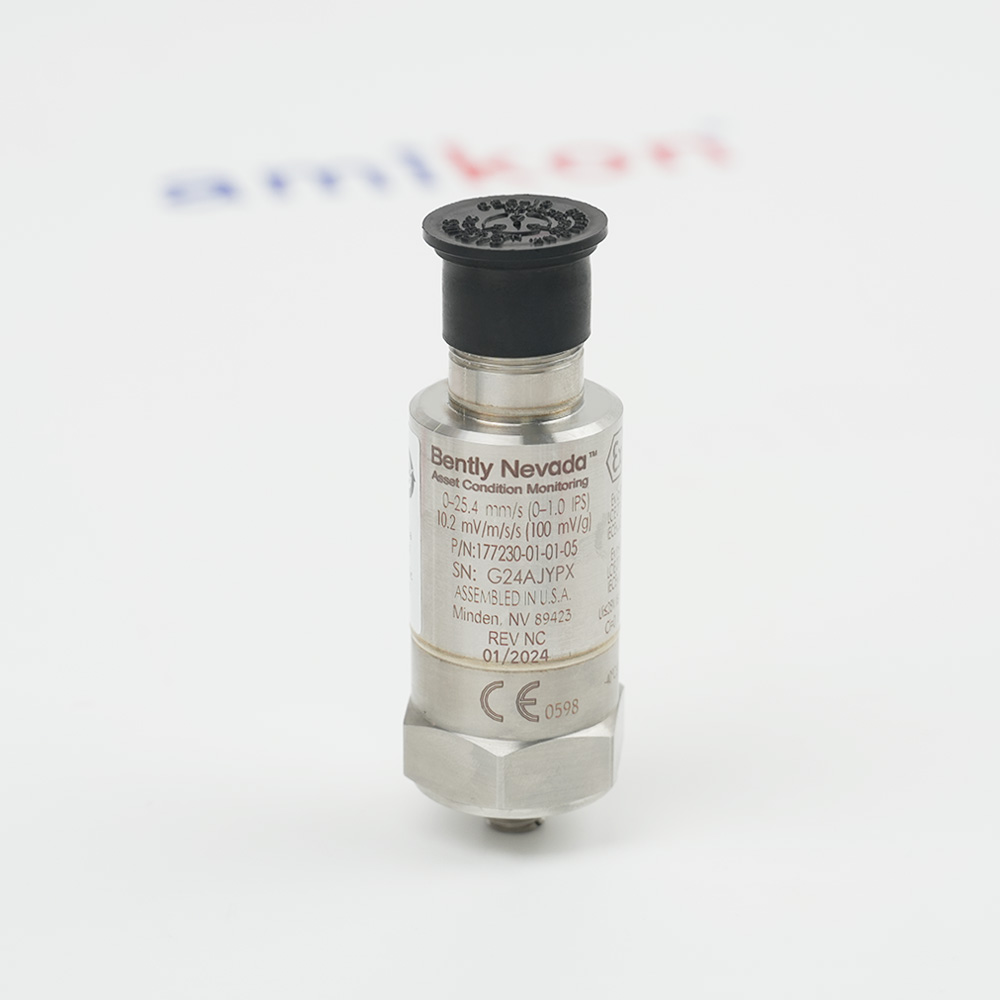
Compare operating and T4 limits
Datasheet 177232 Rev. U lists −40 to +85°C for general operation on page 4. Page 6 gives T4 at Ta ≤80°C for cNRTLus and T4 at Ta = −40 to +80°C for ATEX/IECEx. Ta is the ambient-temperature condition of those approval entries.
If the mounting-point ambient can exceed +80°C, the general +85°C rating does not establish suitability under the cited T4 entries. Record a different applicable approval basis before approving that use.
Check the marking, certificate and drawing
Match the offered unit’s certification marking to the approval required at the site. Baker Hughes points to Approvals Quick Reference Guide 108M1756 for country- and product-specific listings. Its cNRTLus entry requires installation per drawing 177234.
For ATEX/IECEx Zone 0/1, page 6 requires connected equipment and cable parameters to meet the listed entity conditions; Zone 2 has a separate supply-parameter condition. Add the applicable certificate, drawing and circuit data to the approval file. Record any missing document and the person responsible for obtaining it.
See the 177230 transmitter
Product appearance only. This video provides no technical test or approval evidence. Watch on YouTube ↗
Do not use the supply range as an entity check
Page 3 specifies 12–30 Vdc normal excitation, with current limited to 40 mA. Page 6 separately lists hazardous-area entity parameters: Ui = 28 V, Ii = 120 mA, Pi = 1 W, Ci = 0 and Li = 121.06 µH.
For an intrinsically safe loop, compare the associated apparatus and cable data with the applicable entity limits and installation conditions. The 30 Vdc operating maximum does not establish that a 30 V intrinsically safe circuit is permitted. Record the approval route and circuit data used in the assessment.
Record four checks before purchase approval
Keep the four checks below with the purchase approval. Leave a check open when its evidence is missing.
| Decision item | Evidence to record | Result to document |
|---|---|---|
| Product identity | Installed and offered nameplates; complete AA-BB-CC codes | Record any range, frequency or approval-option difference |
| Approval and temperature | Offered marking, applicable certificate, site approval and mounting-point ambient | Confirm the relevant T4 Ta limit covers the site |
| Installation | Applicable drawing, including 177234 where required, and conditions of safe use | Identify each condition the installation must meet |
| Circuit | Associated apparatus, cable data and relevant entity parameters | Record the responsible engineer’s circuit assessment |
Questions to resolve before ordering
Can +85°C be used as the T4 ambient limit?
No. The cited T4 entries on page 6 end at +80°C ambient; +85°C is the general operating limit on page 4.
Are 177230-01-01-05 and 177230-01-02-05 interchangeable?
Not on the part number alone. BB = 01 is 10 Hz–1 kHz RMS; BB = 02 is 3 Hz–1 kHz peak. Match the required output to the installed configuration. Amikon lists 177230-01-01-05 and 177230-01-02-05 separately.
What should accompany a replacement enquiry?
Send both nameplates, the required approval marking, area classification, maximum ambient at the mounting point, installation drawing and quantity. Ask which certificate and exact-item images can be supplied. Email info@amikon.cn or contact Amikon.