
-
Please try to be as accurate as possible with your search.
-
We can quote you on 1000s of specialist parts, even if they are not listed on our website.
-
We can't find any results for “”.
How to Implement Version Control for PLC Programs: Change Management
In plants that run around the clock, the best compliment you can pay a control system is that it’s boring. Predictable. Uneventful. As a systems integrator who has been the last person called at 2:00 AM more times than I care to count, I’ve learned that most “surprises” on the plant floor trace back to change. A small logic tweak that never made it into the project-of-record. A field adjustment that lived only on a laptop. A firmware bump that quietly invalidated a tested configuration. Version control for PLC programs is the discipline that turns those surprises into manageable events. Done well, it becomes a reliable partner to your commissioning, maintenance, safety, and compliance workflows.
This article lays out a pragmatic approach to implementing version control for PLCs. It defines the terminology that auditors and engineers care about, explains the realities of binary project files and vendor tooling, compares practical solution patterns, and describes a change management model that fits the way plants actually operate. Where I cite research or industry perspective, I name the publisher so you can track it in your own references. Where I infer details based on common field practice, I say so and note my confidence.
What Version Control Means in OT
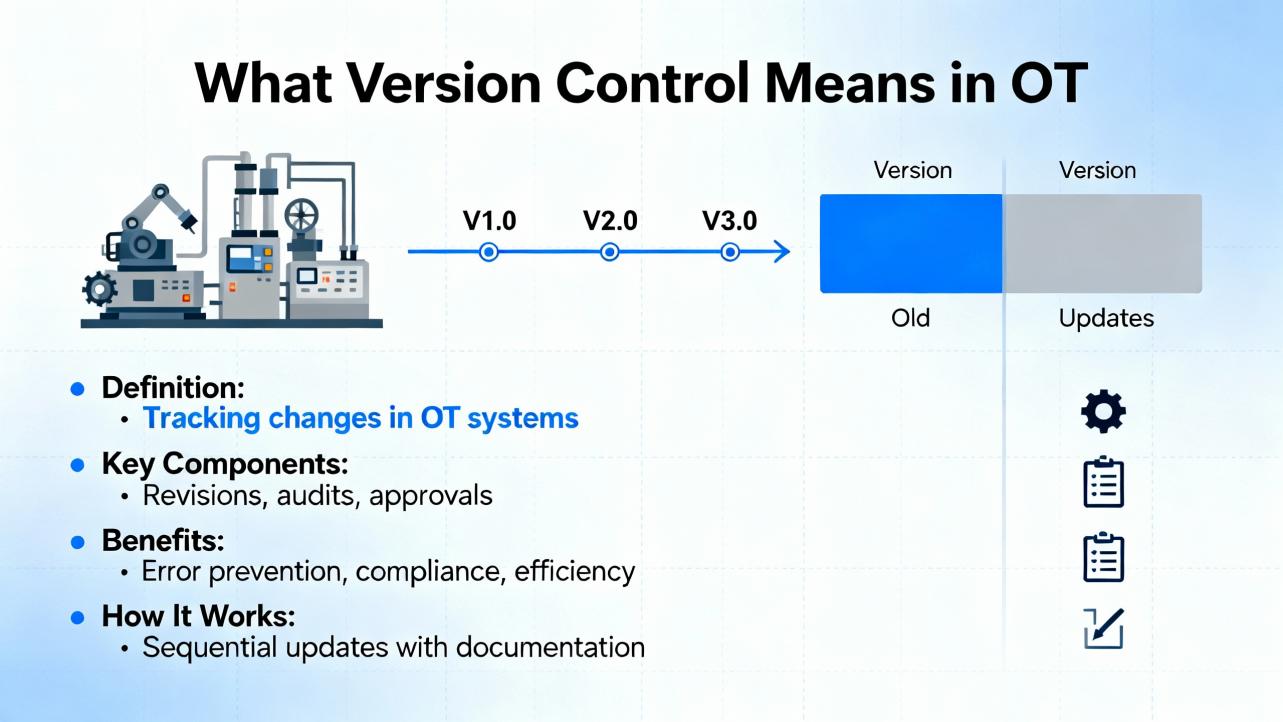
In industrial automation, version control is not just about code. It is a systematic approach to managing changes across automation assets, including PLC programs, HMI projects, device settings, firmware versions, and sometimes the operating data that explains how a line behaved at a point in time. AMDT frames version control in industrial systems as logging every device setting, driver version, and operational datum so that teams can compare states, undo changes, and recover quickly after an interruption. That description is aligned with what seasoned controls teams do in practice: they keep both the program history and the machine’s known-good state within arm’s reach.
There is also a helpful distinction between a version and a revision. Document Locator’s guidance explains that a version is any snapshot in the history as work evolves, while a revision marks an approved, published state. In a plant context, treat the ladder edits you test on a bench or a digital twin as versions, and treat the configuration you approve for production as a revision. When you tag a release that is ready to download to the controller, you are producing a revision. This distinction makes audits and handovers easier because it cleanly separates engineering work-in-progress from the sanctioned build.
Why It Matters on the Plant Floor
Downtime is expensive even before you count scrap and secondary impacts on upstream and downstream cells. When a failure is rooted in a logic change, every minute you spend hunting for the latest stable program is a minute you are not producing. AMDT emphasizes disaster recovery as a core outcome of industrial version control, and that tracks with field experience: if you can identify the last known-good project quickly and prove its pedigree, you minimize time to restore.
Version control also affects productivity and quality. Automation.com describes how Git-based workflows bring auditable history, branching, and rollback to industrial teams, replacing ad‑hoc archive folders and email attachments with a single source of truth. Control Engineering highlights practical wins such as browser-based diffs for ladder logic and function blocks, which reduce review time and improve traceability. Forrester’s research, cited in that context, reports significant improvements in developer onboarding speed and perceived code quality when teams adopt modern version control. Even though those figures are from software contexts, the same mechanisms—clear diffs, review gates, and easy rollback—reduce risk in controls work. Based on experience integrating these practices into commissioning and maintenance, I am confident the same patterns bring measurable gains in plants.
PLC Reality Check: Binaries, Vendors, and Practical Constraints
Unlike source code for business applications, many PLC project files are binary blobs. Rockwell’s .ACD files, for example, do not lend themselves to line-by-line diffs, and several vendors’ XML formats reorder content or regenerate IDs in ways that create noisy or unmergeable changes. Practitioners on Software Engineering Stack Exchange have called out those limits. TwinCAT’s shift to XML brought better transparency but still produced awkward diffs until file formats improved, and even then concurrent merges remain risky. On the Rockwell side, forum discussions and Stack Overflow notes explain that multiple engineers can perform online edits on a running controller, but the offline file of record is easily corrupted by “who saved last” if collaboration isn’t tightly coordinated.
These realities don’t make version control impossible; they shape how you do it. In many environments, the answer is to store the native project file as a binary artifact under rules that prevent blind merges, then export a human-readable representation—an L5X for Rockwell, a structured text export for systems that support it—for diffs and reviews. Vendor compare tools also remain valuable. Rockwell’s compare utilities generate meaningful reports even when a Git-style diff cannot. The net effect is a workflow where the binary is authoritative for downloads and the text export is authoritative for change visibility.
Change Management That Fits OT
A workable model for PLC change management borrows a few proven ideas from IT while respecting controls constraints. Treat the main branch as your project-of-record. Require every proposed change to originate in a short-lived branch, even if that branch exists on a laptop during a site visit with intermittent connectivity. Describe every commit in terms of why it exists and how you validated it. Use merge requests to stage code review, and keep reviewers focused by including vendor compare reports or visual diffs that show exactly what changed at the rung or block level. When a change is approved and tested, tag the merge to main with a semantic version or a date-based release that includes machine identifiers. That tag is your revision.
Management of change does not end at merge. Controls teams must capture the deployment event. Record who downloaded, which controller received the build, what firmware level was on the target, and any checksum or signature the controller reports for verification. In regulated environments, bind that record to a deviation ticket or an engineering change order to keep the audit trail intact.
Offline edits during commissioning are a fact of life. To handle them, adopt a “field branch” convention. If you must patch live logic for safety or throughput, create a branch in your repository that carries the machine identifier and a timestamp. Pull a backup from the controller immediately after the intervention, export the human-readable form, and push both artifacts with notes. That extra step is cheap insurance; it prevents field changes from becoming lost tribal knowledge.
Tooling Options and Tradeoffs
The market offers several patterns for version control in automation. Each works within specific constraints and delivers different visibility and control. The comparison below summarizes the options I have seen succeed.
| Option | What it is | Strengths | Limits | Where it fits |
|---|---|---|---|---|
| Archive folders | Manual copies of project files to dated folders on a shared drive | Minimal setup, works with any vendor file | High manual effort, no diffs, brittle collaboration, weak audit trail | Small, stable machines with rare changes; early-stage stopgap |
| Git with binary blobs | Standard Git repo storing native project files as binaries | Single source of truth, offline commits, history and tags | No meaningful diffs or safe merges for binaries; requires policy discipline | Teams beginning to standardize; sites with strict IT rules |
| Git plus PLC-aware diffs | Git plus tools that render ladder, SFC, FBD, and ST so changes are visible | True code reviews, visual diffs, easier collaboration and rollback | Licensing and training, vendor coverage varies by tool | Fast-changing lines, multi-site teams, regulated industries |
| Vendor asset management | PLC vendor systems that automate backups, access, and audit | Controller-aware backups, centralized policy, audit logs | Proprietary scope, cost, varying diff visibility | Plants standardized on a single vendor stack |
| Centralized VCS (SVN/Perforce) | Server-centric version control with locking and exclusive checkout | Strong control over binaries, enforced single source of truth | Connectivity dependence, admin overhead | Teams with many non-mergeable files and strict governance |
Automation.com explains how standard Git workflows raise the floor on collaboration and recovery for PLC programs. Control Engineering showcases how visualization narrows the gap between binary project storage and human review. Perforce’s guidance adds that centralized systems with exclusive checkout can be a better fit for large binary assets. Based on plant adoption patterns, the hybrid approach—Git for history and portability plus PLC-aware visualization for reviews—delivers the most value for the broadest set of teams.
Designing a PLC-Friendly Repository
A PLC repository benefits from structure. Store the native project files in an artifacts area with a rule that they cannot be merged automatically. Include text exports that are regenerated on every commit via a simple script or a repeatable manual step. Keep HMI projects alongside PLC logic because many changes span both. Track device configurations such as drive parameter sets, safety controller projects, fieldbus maps, and switch configurations in human-readable forms where possible. Record firmware levels and vendor library versions in a manifest that travels with the release. Use tags to mark releases that went to production, and keep release notes alongside the tag so a night-shift technician can understand what changed without hunting through commit history.
When proprietary formats make exports messy, keep your process honest by attaching vendor compare reports to the merge request. That keeps reviewers grounded in the PLC’s idioms rather than the quirks of XML or vendor tooling.

Small, Stable Machines Versus Fast-Changing Lines
Omron’s perspective is balanced here. For isolated, stable machines that rarely change, a disciplined manual backup or SD card snapshot can be adequate. It is worth using a simple version control repository to store those snapshots with notes; the added audit trail costs very little. For connected plants, complex lines, and frequent recipe or equipment changes, the calculus shifts. You need an auditable, collaborative system that integrates with how your engineers actually work, including offline edits during site work, code reviews before shift change, and branch-based workflows to protect the mainline. Trying to manage that complexity with dated file names and shared drives consumes more engineering time than it saves.
Cybersecurity and Governance
A version control system becomes a system of record for your control logic. That makes it a target and a governance focal point. Harness’s best practices for version control reinforce several controls that transfer cleanly to OT: enforce strong authentication and role-based access, avoid committing secrets by using a secure store, and log access and changes comprehensively. In plants with elevated risk, require approvals for merges that affect safety-rated logic and isolate repositories by line or area to limit blast radius. When policy requires it, insist on exclusive checkout or locks for certain binaries so no two engineers can overwrite each other’s work by accident. In my experience, the IT security controls you already use translate well; the challenge is making them frictionless enough that engineers follow them under time pressure.
Disaster Recovery That Actually Works
AMDT’s disaster recovery emphasis is the right north star: minimize downtime by restoring the last known-good system state decisively. The practical recipe is simple. Keep an authoritative, tagged revision that includes the controller program, the HMI project, configuration sidecars, and a firmware manifest. Test your restore procedure on a spare controller or a test rack. Verify, do not assume, that the tag you marked as ready truly downloads cleanly to a target with the documented firmware. Keep a runbook with screenshots and controller fingerprints so a technician on a weekend shift can restore with confidence. If your PLC supports on-device SD backups, as Omron Sysmac does, keep a recent snapshot on the controller and a synchronized copy in your repository. This layered approach gives you a fast local restore and a defensible history for audits.
Implementation Playbook: From Zero to Disciplined Control
The first success criterion is to start. Inventory your controllers, HMIs, and device configurations and bring the projects into a repository with clear naming tied to site, line, and machine. Establish a minimal workflow that includes short-lived branches, descriptive commits, and review before release. Add PLC-aware visualization as soon as practical so reviewers can see rung-level changes without opening vendor IDEs. Standardize release tagging and attach vendor compare reports so every release carries human-readable evidence of change.
Training is the multipler. Teach engineers why small, frequent commits help isolate bugs and how to write commit messages that describe intent. Make branch naming conventions short and obvious. Show technicians where to find the release that matches the machine in front of them and what evidence to trust. Do a trial restore before a holiday shutdown so your first test does not happen on a Saturday night. None of this requires a heroic budget, but it does require consistency.
Buying and Care Tips for PLC Version Control
The right choice depends on your vendor mix, change frequency, team size, and governance requirements. When I evaluate options, I look for a few specific capabilities. The platform should show real diffs for ladder logic, structured text, function block diagrams, and sequential function charts so reviewers can answer what changed without opening an IDE. It should handle binary project files without trying to auto-merge them and should support policies like file locking or exclusive checkout where needed. It should allow offline work for field engineers with later synchronization. It should centralize backups automatically and verify that the project-of-record matches what is in the controller. It should track who, what, when, and why with enough richness to satisfy auditors, and it should integrate vendor coverage for the PLC families you actually run, such as Rockwell, Siemens, Beckhoff, and CODESYS-based controllers. Control Engineering and Automation.com both describe platforms that meet parts of this list with Git at the core. If you are standardized on a single vendor, a vendor-provided asset management tool can be the shortest path to disciplined backups and access control.
Costs and operations matter as much as features. Consider whether you need cloud hosting, on-prem servers, or a hybrid. Match licensing to the number of engineers and the way you staff shifts. Budget a little time to automate exports so every commit carries a readable snapshot. Plan for basic user training and a short internal playbook so new engineers can get productive in a day rather than a week. Perforce’s guidance reminds us that centralized systems shine with large binary assets; that capability can be worth the administrative overhead in the right environment.
If you rarely change a line and can tolerate slightly longer mean time to restore, a disciplined archive folder plus a lightweight repository for history may be enough. If you change frequently or face regulated audits, invest in Git plus PLC-aware visualization or a vendor asset management system with robust audit trails. That investment pays back quickly in shorter commissioning cycles and faster, safer recoveries.
Common Pitfalls and How to Avoid Them
The most common failure pattern is assuming that a shared network folder is good enough. Folders cannot tell you who changed what or why, and they do not help when two engineers copy in different directions. A close second is treating a Git repository as a dumping ground for binaries without any process for exports or compare reports; that approach leaves reviewers blind and produces false confidence. Online edits that never make it back to the repository are another trap. The way out is to make the path of least resistance also the right one. Provide a simple script or repeatable step that exports the readable form on every save. Require a merge request for any change that will go to a machine. Make it obvious how to capture a field change as a branch with notes. When plant priorities pull hard, engineers will follow the easiest path; design the process so the easiest path produces a traceable result.

A Realistic Rollback Scenario
Imagine a throughput improvement that adds a new inspection step on a packaging line. The engineer adds a few rungs and tweaks a motion profile, then validates on a digital twin and during a short window on the real cell. Something subtle slips through, and two days later a sensor misalignment triggers unexpected behavior at 3:00 AM. With version control, the on-call technician can find the last revision tag for that machine, read the release notes, and compare the approved change against the current controller state using a vendor compare tool. Seeing that only one routine differs, the technician can either roll back the whole project to the previous revision or surgically restore the routine. Because the repository stores both the binary and the human-readable export, it is easy to confirm that the restore matched the intended state. Production resumes quickly, and the post‑incident review uses the visual diff to pinpoint the logic that caused the misread.
Takeaway
Version control for PLC programs is not a luxury. It is the foundation for predictable change and fast recovery. The right combination of repository structure, PLC-aware visualization, vendor compare tools, and lightweight process transforms change from a risk into a routine. AMDT’s focus on disaster recovery, Omron’s guidance on fit-for-purpose strategies, Perforce’s lessons about managing binaries, and the Git-centered practices covered by Automation.com and Control Engineering point to the same conclusion: start simple, make changes visible, keep the project-of-record trustworthy, and train your team to follow the path that produces a traceable history. If you do those things, your next 2:00 AM call will be shorter and much less exciting.
FAQ
How do I handle PLC projects that are binary and don’t diff well?
Store the native project as a binary artifact and do not allow automatic merges. Export a human-readable form such as L5X or structured text on every commit and use vendor compare tools for validation. This hybrid approach combines a trustworthy download artifact with meaningful review visibility. This practice is widely used in plants and is supported by guidance from practitioner communities and publishers such as Perforce and Control Engineering.
Is a vendor asset management system enough on its own?
Vendor systems often excel at automated backups, access control, and audit logs, which are essential. They may not provide the best cross‑vendor visual diffs or branch-based workflows. Many teams pair a vendor tool with Git-based history and PLC-aware diff viewers for the best of both worlds. Based on field deployments, I am confident this pairing covers most needs in mixed-vendor environments.
When is a simple archive folder acceptable?
If a machine is isolated, changes are rare, and downtime risk is modest, a disciplined archive folder policy with clear naming and off‑host backups can suffice. Omron notes this fit. It is still wise to keep those archives under a lightweight repository to preserve authorship and timestamps.
How should we structure branches for controls work?
Keep branches short-lived and focused on a single change. Use a clear naming convention tied to the line or machine. Require a merge request with visual diffs or compare reports and a brief validation note. Tag the approved merge as a revision with identifiers for site and machine so technicians can find the right build quickly.
What about offline edits during commissioning or emergency work?
Treat field edits as first-class changes. After the intervention, pull a controller backup, export the readable form, and push both to a branch with notes, then reconcile into the mainline. This habit prevents the “fix that lives only on the controller” problem and keeps your project-of-record aligned with reality.
Do we need cloud hosting to do this well?
Cloud hosting is not required. Git and centralized version control work on‑prem just fine. Cloud adds convenience for multi‑site collaboration and continuous backup, which can raise resilience. Choose based on your connectivity, security posture, and procurement preferences. Automation.com and Control Engineering discuss both on‑prem and cloud approaches; in my experience, either can be successful with the right governance.
References
- https://www.academia.edu/90990197/Object_Oriented_Development_Methodology_for_PLC_software
- https://opensiuc.lib.siu.edu/cgi/viewcontent.cgi?article=1029&context=uhp_theses
- https://www.ssterman.web.illinois.edu/assets/pdfs/towards_creative_version_control.pdf
- https://formal.kastel.kit.edu/projects/improve/pubs/etfa2015.pdf
- https://www.plctalk.net/forums/threads/best-practices-for-maintaining-version-control.80443/
- https://www.automation.com/article/git-based-version-control-industial-automation
- https://www.controleng.com/how-to-simplify-plc-control-device-management-with-git-version-control-auto-backup/
- https://www.copia.io/blog/basic-binary-blobs-vs-groovy-git-a-comparison-of-plc-version-control-strategies
- https://corsosystems.com/posts/operational-technology-101-plc-backups-and-version-control
- https://blog.documentlocator.com/the-significance-of-document-version-control-and-revision-control/
Keep your system in play!

Related articles Browse All
-
 amikong NewsSchneider Electric HMIGTO5310: A Powerful Touchscreen Panel for Industrial Automation2025-08-11 16:24:25Overview of the Schneider Electric HMIGTO5310 The Schneider Electric HMIGTO5310 is a high-performance Magelis GTO touchscreen panel designed for industrial automation and infrastructure applications. With a 10.4" TFT LCD display and 640 x 480 VGA resolution, this HMI delivers crisp, clear visu...
 -
 BlogImplementing Vision Systems for Industrial Robots: Enhancing Precision and Automation2025-08-12 11:26:54Industrial robots gain powerful new abilities through vision systems. These systems give robots the sense of sight, so they can understand and react to what is around them. So, robots can perform complex tasks with greater accuracy and flexibility. Automation in manufacturing reaches a new level of ...
 -
 BlogOptimizing PM Schedules Data-Driven Approaches to Preventative Maintenance2025-08-21 18:08:33Moving away from fixed maintenance schedules is a significant operational shift. Companies now use data to guide their maintenance efforts. This change leads to greater efficiency and equipment reliability. The goal is to perform the right task at the right time, based on real information, not just ...


- Q&A
- Policies How to order Part status information Shipping Method Return Policy Warranty Policy Payment Terms Email Marketing Policy VAT and Import Information
- Asset Recovery
- We Buy Your Equipment. Industry Cases Amikong News Technical Resources Why choose us
- Registered Address
-
32D Guomao Building, No.388, Hubin south Road, Siming district, Xiamen,Fujian, China

Leave Your Comment