


Start with the channel, not the spare-parts shelf.
The first question is straightforward: does the monitoring channel expect the signal that the proposed accelerometer will produce?
A replacement accelerometer can arrive with the expected label family and still need a closer engineering review before installation. This matters when an enquiry asks for “330400 or equivalent,” when a supplier proposes an alternative, or when a maintenance team finds a different model in stores.
The comparison below is a selection aid, not an approval of interchangeability. Confirm the installed configuration before releasing an order.
The two specifications to compare first.
Baker Hughes lists these nominal values in its 330400 and 330425 datasheet, document 141638 Rev. AB, pages 1–2.
| Specification | 330400 | 330425 |
|---|---|---|
| Nominal sensitivity | 100 mV/g | 25 mV/g |
| Acceleration range | 50 g peak | 75 g peak |
The range figures apply within the stated 10 Hz–15 kHz span. The datasheet identifies conditions that can reduce that range; these are not unconditional limits for every installation.
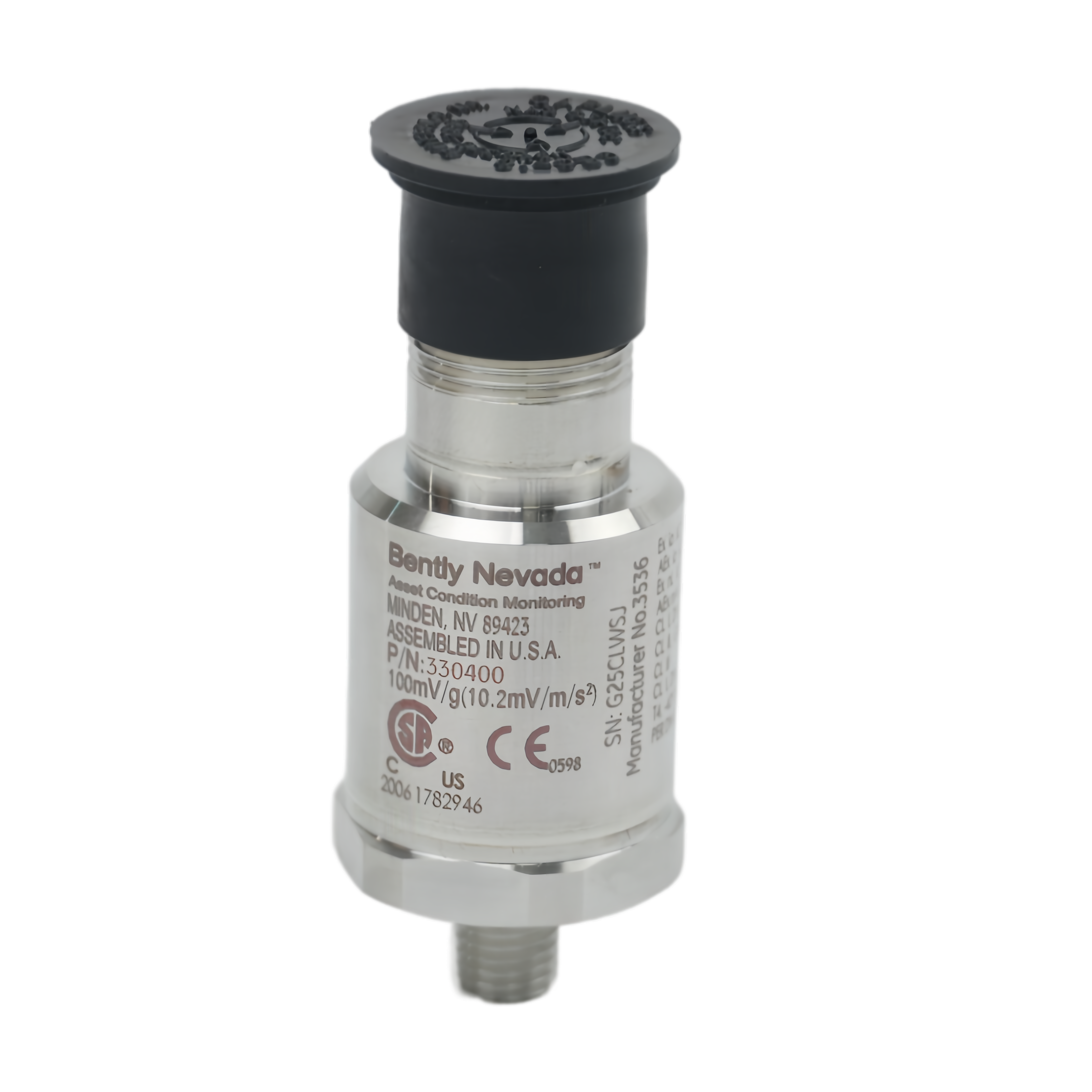
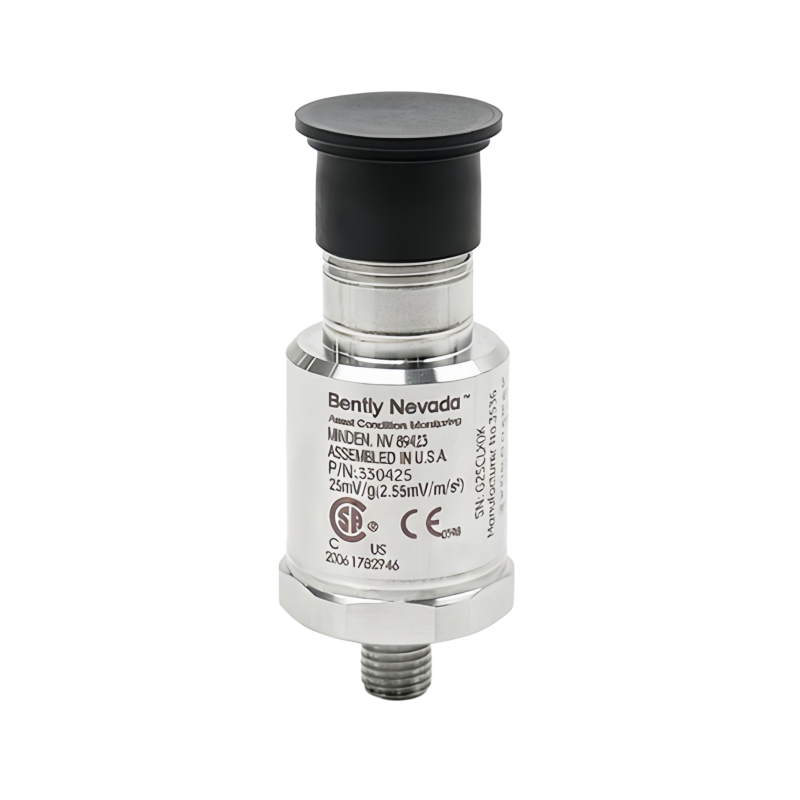
User-supplied product photographs. The pictured suffixes are examples; confirm the complete installed code and channel configuration before ordering.
Amikon lists specific configurations such as 330400-01-00 and 330425-01-05. Treat them as separate ordering references, not an interchangeable pair.
330400 and 330425 video
Video supplied for this article. Confirm part identity and engineering suitability from the relevant records; the video alone is not acceptance evidence.
A normal-looking reading may still be scaled incorrectly.
Consider a simplified, hypothetical 1 g input amplitude. A 25 mV/g sensor produces 25 mV. If the receiving channel interprets that voltage at 100 mV/g, its nominal calculation is 0.25 g. In the reverse mismatch, 100 mV interpreted at 25 mV/g gives 4 g.
Illustrative reading when a lower-sensitivity sensor feeds a channel set for 100 mV/g.
Illustrative reading for the reverse nominal mismatch.
A display can show a changing value without proving that its engineering units are scaled correctly. An apparently lower reading after maintenance should prompt a configuration review before anyone concludes that machine condition has improved.
Identify the installed arrangement.
-
01Physical evidence
Photograph both labels
Record the complete ordering code, serial number and visible revision for the installed sensor and proposed spare. Mark unreadable information as unknown; do not reconstruct it from a similar listing.
-
02Ordering detail
Keep the full ordering identity
The manufacturer's ordering structure separates mounting-thread and approval options. A base model alone loses information needed for an exact purchase. Check certification and installation requirements for the actual configuration and location.
-
03Channel record
Retrieve the approved channel configuration
Ask the equipment owner for monitor or acquisition-channel identity, transducer type, sensitivity, units, filters and measurement processing. A screenshot may start an enquiry; a controlled record is preferable for the final engineering decision.
-
04Change history
Reconcile changes since installation
Compare the installed arrangement with drawings and modification records. Repeating an old purchase order may reproduce a requirement that is no longer current.
Before asking for an alternative: bring the label photos, complete ordering code, approved channel settings and relevant modification record together. A matching base model alone does not resolve channel suitability.
Keep the purchase and engineering decisions separate.
Exact-code replacement
Establish the item identity, condition, included supply, traceability and required documents against the approved purchase requirement.
Proposed alternative
Request an additional engineering review of the complete measurement chain and intended duty. Quote the alternative on a separate line with the differences stated explicitly.
“Quote the installed code only” is clearer than “equivalent acceptable” when no substitution review has been completed. Availability alone should not decide a change to a monitoring arrangement. Compare the project work needed for configuration review, installation and acceptance, as well as component price.
Agree what will prove the replacement was accepted.
A useful replacement package identifies what was ordered, what arrived, what was installed and what was verified. Agree the required records before the equipment is taken out of service.
A practical acceptance record can cover
- Identification: delivered labels and documents against the approved order.
- Supply scope: sensor and any separately required connection or mounting items.
- Configuration: approved settings and authorized changes.
- Measurement verification: agreed method, equipment, conditions and criteria.
- Handover: installed identity, results, exceptions and sign-off.
These are documentation categories, not a manufacturer commissioning procedure. A sensor-only check and an end-to-end channel check answer different questions; the site-approved acceptance plan should state which is required. Follow applicable manuals and site procedures for isolation, installation, testing and return to service.
Send a quotation request that describes the actual job.
For a comparable offer, include the complete installed code, readable nameplate photos and quantity per item. State whether this is an exact replacement or an alternative that needs review.
Ask for offered configuration, availability, lead time, warranty terms and document scope in writing. Sharing application details with a supplier does not constitute manufacturer compatibility approval.
Send the complete part number, quantity and label photo first. Include site-approved engineering information if an alternative is under review.
Prepare an enquiry →Questions before purchase release.
Can a 330425 replace a 330400 without changing anything else?
Do not approve that assumption from the model names alone. Have the responsible engineer review the proposed sensor against the complete installed measurement chain and its configuration.
Does the model with the larger range always make a better spare?
No. The spare must meet the measurement requirement and work with the approved channel arrangement. Range alone leaves scaling unanswered.
Is a normal-looking reading enough to accept the replacement?
No. An acceptance record should identify verification method and conditions rather than rely only on a plausible display value.
Can existing alarm settings simply be retained?
Do not decide this from the sensor comparison. Changes to a protection or monitoring channel require the site's engineering review.
What if the sensor label is unreadable?
Provide photos, equipment tag and historical records, and state the uncertainty. Resolve identification before selecting the closest-looking catalogue entry.
What is the quickest way to request the right quotation?
Send the complete code and quantity, with a readable label photo and a clear exact-replacement or alternative-review instruction. Add document and delivery needs.
Baker Hughes, 330400 and 330425 Accelerometer Acceleration Transducers, document 141638 Rev. AB, especially pages 1–2 and 8. The supplied article states it was checked 23 October 2026. The document carries a 2025 copyright notice; an exact publication date was not established.
For broader product-family context, see Amikon's Bently Nevada system selection guide. This preview does not authorize live replacement, protection-setting changes or bypassing protective functions.







Leave Your Comment