
-
Please try to be as accurate as possible with your search.
-
We can quote you on 1000s of specialist parts, even if they are not listed on our website.
-
We can't find any results for “”.
A Guide to Selecting the Right Bently Nevada System for Your Industrial Application


Machinery downtime kills profits. Picking the correct Bently Nevada System keeps production running and protects critical assets from catastrophic failure. Whether you need to source legacy components or upgrade modern architectures, Amikong connects facilities with essential automation parts.
What You Need to Monitor First
Before requesting a quote from a supplier like Amikong, pause to evaluate the machine itself. What specific behavior demands observation? Different assets communicate health through distinct languages. A fluid-film bearing compressor reveals condition through shaft motion, while a rolling-element bearing pump screams status through casing vibration. Effective protection starts when you understand the failure modes most likely to compromise asset integrity, not just when you look up a part number.
How Machines Behave Differently
Industrial assets generally fall into two categories: those employing fluid-film bearings and those utilizing rolling-element bearings. Each requires a fundamentally different approach. Fluid-film bearings, common in large steam turbines, support the rotor on a thin wedge of oil. The heavy casing dampens energy, preventing it from reaching the exterior. Measuring vibration on the casing provides little insight into shaft dynamics. Here, the goal involves measuring displacement—the physical movement of the shaft relative to the bearing. Bently Nevada Shaft Vibration Sensors excel in such scenarios.
Conversely, machines with rolling-element bearings transmit forces directly to the housing. The casing itself vibrates. Monitoring objectives shift from observing the shaft to measuring absolute motion. Seismic sensors, which measure velocity or acceleration, become the primary tools.
How Amikong Helps You Plan
Navigating definitions is the first step. The second involves sourcing hardware that matches the physics. Amikong plays a crucial role here. Facilities often operate a mix of decades-old turbines and modern compressor trains. A maintenance planner might need a "shaft vibration probe," but the specific model depends on whether the system is a modern 3500 series or a legacy 3300 setup. Amikong’s inventory of active and obsolete components allows for a seamless match between engineering requirements and supply chain reality.
Why Eddy Current Sensors Are the Standard
For critical heavy industry applications, Bently Nevada Eddy Current Sensors represent the gold standard. They act as an "all-seeing eye," peering through the opaque, hostile environment of a bearing housing to report the precise location of a spinning shaft.
Why the 3300 XL 8 mm System Is Everywhere
The 3300 XL Series Bently Sensors stand as the most ubiquitous monitoring tools globally. The 8 mm system offers a linear range of 80 mils (2 mm), complying fully with American Petroleum Institute (API) Standard 670. You can swap parts easily. A technician can replace a damaged 8 mm probe with any other standard 3300 XL 8 mm probe without recalibration. Such flexibility reduces maintenance overhead. Amikong maintains a deep stock of these probes. Since they serve as the default choice for radial vibration on most fluid-film bearing machines, availability is critical. A plant manager facing a startup delay due to a damaged probe can rely on Amikong to supply the necessary component immediately.
When You Need the Extended Range of the 11 mm System
Some scenarios demand a wider field of view. The 3300 XL 11 mm system offers a linear range of 160 mils (4 mm). One primary use involves rod drop monitoring on reciprocating compressors. As rider bands wear down, the piston rod drops relative to the cylinder. Monitoring the gradual descent prevents metal-to-metal contact. Since the rod moves significantly, the 80-mil range of a standard probe may prove insufficient. The 11 mm probe guarantees the target remains within the linear sensing range.
What to Do When Space Is Tight
Industrial design does not always prioritize sensor installation. Engineers frequently encounter situations where the available counterbore is too narrow. The 3300 XL NSv (Narrow Side View) system addresses such geometric constraints. Featuring a smaller tip and a focused RF field, it fits where standard probes cannot. Amikong supplies NSv probes to facilities maintaining refrigeration compressors and smaller process gas machines where standard probes simply will not fit.
How Velocity Sensors Capture Casing Vibration
Not every machine allows for internal probing. Many pumps, fans, and motors utilize rolling-element bearings where rotor dynamics transmit efficiently to the casing. For such assets, taking the "pulse" from the outside works best.
Why We Moved to Piezo-Velocity Sensors
Historically, velocity measurements relied on moving-coil sensors. Such devices functioned like a speaker in reverse. While effective, they contained moving parts, creating susceptibility to wear. The modern standard is the 330500 Velomitor Piezoelectric Velocity Sensor. It contains no moving parts. A piezoelectric crystal generates a charge when squeezed, which internal electronics integrate into velocity. Solid-state design allows mounting at any angle. For plants upgrading from legacy Seismoprobes, the Velomitor offers a drop-in reliability improvement.
Why Cooling Towers Need Special Sensors
Cooling towers pose a unique challenge. Massive fans turn at very low speeds, often between 100 and 300 rpm. A standard velocity sensor, designed for faster motors, effectively turns a deaf ear to the fundamental running speed of the fan. The 190501 Velomitor CT is engineered specifically for such domain. It features extended low-frequency response, capable of measuring accurately down to 1.5 Hz. Failure to use a low-frequency sensor on a cooling tower is a common oversight. A standard sensor might show "zero vibration" while the fan shakes itself to pieces. Amikong helps reliability engineers avoid such traps, supplying the correct 190501 variants for slow-speed applications.
When You Should Choose Accelerometers
For gearboxes, where mesh frequencies reach several kilohertz, acceleration is the required parameter. The 330400 and 330425 Accelerometers capture rapid, high-impact events. Detecting a cracked gear tooth often requires looking at the second or third harmonic of the gear mesh frequency. An accelerometer captures that high-frequency "ping," whereas a velocity sensor would smooth it out.
How You Handle Specialized Applications
Vibration is not the only parameter dictating machine health. Large industrial assets undergo physical changes—thermal growth, valve movement, rotor positioning—that require specialized linear measurement tools.
Why You Must Monitor Casing Expansion
Large steam turbines are massive thermal engines. During startup, the metal heats up. The rotor expands faster than the heavy shell. Casing Expansion and High-Temperature Casing Expansion Sensors mount on the foundation to monitor the absolute position of the turbine shell. If the "sliding feet" of the turbine bind, the casing cannot expand. It will buckle, causing severe misalignment. Dual LVDTs allow the control room to verify that both sides slide evenly. Amikong supplies such critical LVDT assemblies, including the explosion-proof housings required for power plant environments.
How You Track Valve Position
Valve position is another critical metric. Governing valves control turbine speed. Knowing the precise position is essential for stable control. Bently Nevada Valve Position Sensors (LVDT) provide the positive feedback loop. Designed to withstand vibration near the steam chest, they offer long strokes to track full valve travel. Amikong stocks various lengths, helping plants replace worn feedback sensors during short outages.
How You Monitor Without a Full Rack
Not every machine justifies a full rack system. For smaller air compressors, a "blind" transmitter often serves as the most cost-effective solution. The 990 Shaft Vibration Transmitter connects to a standard proximity probe and outputs a 4-20 mA signal directly to the PLC. The 991 Shaft Displacement Transmitter performs the same function for axial position. Such devices bridge the gap between no monitoring and a full protection suite. Amikong offers such transmitters as a quick retrofit option for plants upgrading auxiliary systems without installing new cabinets.
Building the Complete Bently Nevada 3500 Protection Network
A single sensor is only one piece of the puzzle. A Bently Nevada sensor generates real value only when integrated into a system that interprets signals, drives alarms, and stores data. This is the core logic of the Bently Nevada ecosystem: seamlessly integrating the keen "Eye" (Sensors) with the powerful "Brain" (The 3500 System).
1. The Core Brain: The 3500 Series as the Industry Standard
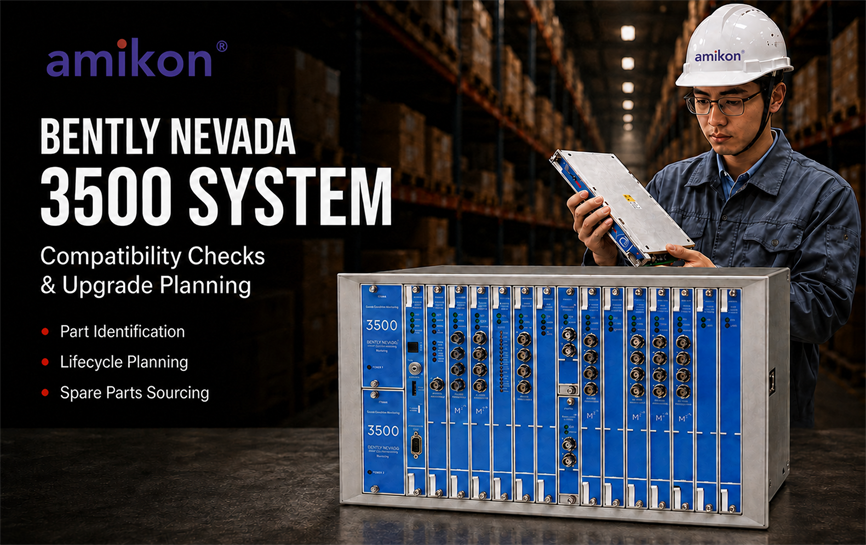
The 3500 Series Machinery Protection System is not just a flagship platform; it is the global standard for machinery protection. Built around the modular 3500/05 System Rack, it allows specific function cards to slide in, creating a customized monitoring solution for critical assets.
The Central Processing Hub:
- Universal Vibration & Position: The 3500/42M Proximitor/Seismic Monitor is the workhorse of the system. It accepts inputs from 3300 XL Probes, 330500 Velomitors, and 330400 Accelerometers to continuously analyze radial vibration, axial (thrust) position, and casing vibration.
- Precision Expansion Monitoring: For large steam turbines, the 3500/45 Position Monitor is essential. It processes signals from LVDTs and 24765 Casing Expansion Sensors to track thermal growth and valve position, preventing catastrophic rotor-stator rubs.
- Speed & Phase Reference: The 3500/25 Keyphasor Module and 3500/50 Speed Monitor provide the critical phase reference required for vector monitoring and overspeed protection.
- Smart Diagnostics: Through the 3500/22M TDI (Transient Data Interface), the hardware connects seamlessly to System 1 software. While the rack (via 3500/32 Relay Modules) protects the machine by tripping it during a fault, the software analyzes the data to explain why it happened.
2. The Keen Eyes: Diverse Sensor Inputs
The power of the 3500 system relies on high-precision data from the field. Bently Nevada offers a specialized matrix of sensors designed to withstand specific industrial environments:
- Eddy Current Sensors (Shaft Vibration & Displacement):
- 3300 XL 8mm & 11mm Systems: Fully compliant with API 670, these offer linear ranges of 80 mils (2mm) and 160 mils (4mm) respectively. They are the industry standard for monitoring radial vibration and thrust position.
- Specialized Applications: The 3300 XL NSv handles tight spaces with limited counterbore clearance, while the 3300 XL 25mm and 50mm systems provide robust Differential Expansion (DE) measurement for large turbines.
- Velocity & Acceleration Sensors (Casing Vibration):
- Velomitor Series: The 330500 Piezoelectric Velocity Sensor eliminates moving parts to prevent wear. For hydroelectric applications, the 330505 Low-Frequency Sensor captures vibrations as low as 0.5 Hz.
- Accelerometer Series: The 330400 and 330425 Accelerometers are designed for high-frequency gear mesh monitoring. For extreme heat, the 330450 HTAS separates the sensing element from the electronics, allowing operation on surfaces up to 400°C (752°F).
- Transmitters for Balance of Plant:
990 & 991 Transmitters: These provide a 4-20 mA output for smaller, less critical machinery (like air compressors), while retaining a "Prox Output" for diagnostic waveform analysis.
3. How Amikong Solves the Obsolescence Challenge
Industrial plants operate on timelines measured in decades. A steam turbine built in 1980 may still run perfectly, but its monitoring system—perhaps a legacy 3300 Series or 7200 Series—is likely long obsolete.
OEMs eventually stop supporting legacy products, and a full system upgrade can cost hundreds of thousands of dollars. Amikong provides a vital lifeline in this scenario:
- Immediate Inventory Access: Amikong stocks discontinued modules, including 3300 Series monitors and legacy 3500 cards (such as older 3500/15 power supplies).
- Avoiding Costly Downtime: If a rack power supply fails, the entire protection system goes dark. Amikong can supply a replacement surplus unit immediately, allowing the plant to restart safely while planning for a future upgrade at their own pace.
- Attention to Detail: Whether it is ensuring 3300 XL extension cables are routed to prevent ground loops or verifying that 3500/92 Communication Gateways are available to maintain data links, Amikong supports the hardware reality of maintaining aging infrastructure.
Contact Amikong Today to Secure Your Components
Accurate data starts with the right hardware. From standard probes on turbines to Velomitors on cooling fans, choosing the correct Bently Nevada Sensor serves as your first line of defense. Amikong strengthens such defense, supplying both current and obsolete components to keep systems online. Understand your machinery, partner with a responsive supplier, and protect your operation. Reach out to Amikong today.
Keep your system in play!
Top Media Coverage
Categories

Related articles Browse All
-
 BlogImplementing Vision Systems for Industrial Robots: Enhancing Precision and Automation2025-08-12 11:26:54Industrial robots gain powerful new abilities through vision systems. These systems give robots the sense of sight, so they can understand and react to what is around them. So, robots can perform complex tasks with greater accuracy and flexibility. Automation in manufacturing reaches a new level of ...
 -
 BlogOptimizing PM Schedules Data-Driven Approaches to Preventative Maintenance2025-08-21 18:08:33Moving away from fixed maintenance schedules is a significant operational shift. Companies now use data to guide their maintenance efforts. This change leads to greater efficiency and equipment reliability. The goal is to perform the right task at the right time, based on real information, not just ...
 -
 BlogThe Evolution of Steam Turbine Control Systems2026-03-31 08:33:35CALL US:+86-18020776786 | E-MAIL:INFO@AMIKON.CN In-depth analysis of the GE Mark VIe control system Mark VIe: A Modern Mainstay for Industry 4.0 Mark VIe's core concepts are "high availability, open connectivity, and intelligent readiness." It utilizes comm...


- Q&A
- Policies How to order Part status information Shipping Method Return Policy Warranty Policy Payment Terms Email Marketing Policy VAT and Import Information
- Asset Recovery
- We Buy Your Equipment. Industry Cases Amikong News Technical Resources Why choose us FAQs
- Registered Address
-
32D Guomao Building, No.388, Hubin south Road, Siming district, Xiamen,Fujian, China

Leave Your Comment