
-
Please try to be as accurate as possible with your search.
-
We can quote you on 1000s of specialist parts, even if they are not listed on our website.
-
We can't find any results for “”.
Discontinued Schneider Modicon Parts: Legacy Modicon System Support


The reality on the plant floor
If you have been around plants as long as I have, you know that “legacy Modicon” usually means “critical, irreplaceable, and running a line nobody dares to touch.” Modicon PLCs, Schneider drives, and Harmony HMIs have quietly run water plants, food plants, and manufacturing lines for decades. The hardware rarely makes headlines, but every time one of those parts goes discontinued, it turns into a production, safety, and budget conversation very quickly.
Industry research cited by RT Engineering and Schneider Electric estimates that roughly $65 billion in industrial automation assets are already at or beyond end of useful life. At the same time, manufacturers still rely heavily on control systems that are 10 to 20 years old or more. Articles from Industrial Automation Co., Hasuka Automation, and Industrial Electrical Warehouse all point to the same pain point: unplanned downtime on old equipment is brutally expensive, and sourcing obsolete automation parts has become a discipline of its own. One UK study reported by The Manufacturer put average unplanned downtime for manufacturers at about £180,000 per hour, a high six-figure hit every sixty minutes.
In this article, I will walk through how discontinued Schneider Modicon parts fit into that picture, what “obsolete” actually means in Schneider’s world, and how to keep legacy Modicon systems running without gambling your plant on eBay finds and tribal knowledge. The perspective is pragmatic and field-tested: treat legacy systems as assets, not fossils, and support them with the same discipline you would apply to a new platform.
Why Modicon and Schneider parts become obsolete
Technology cycles and component availability
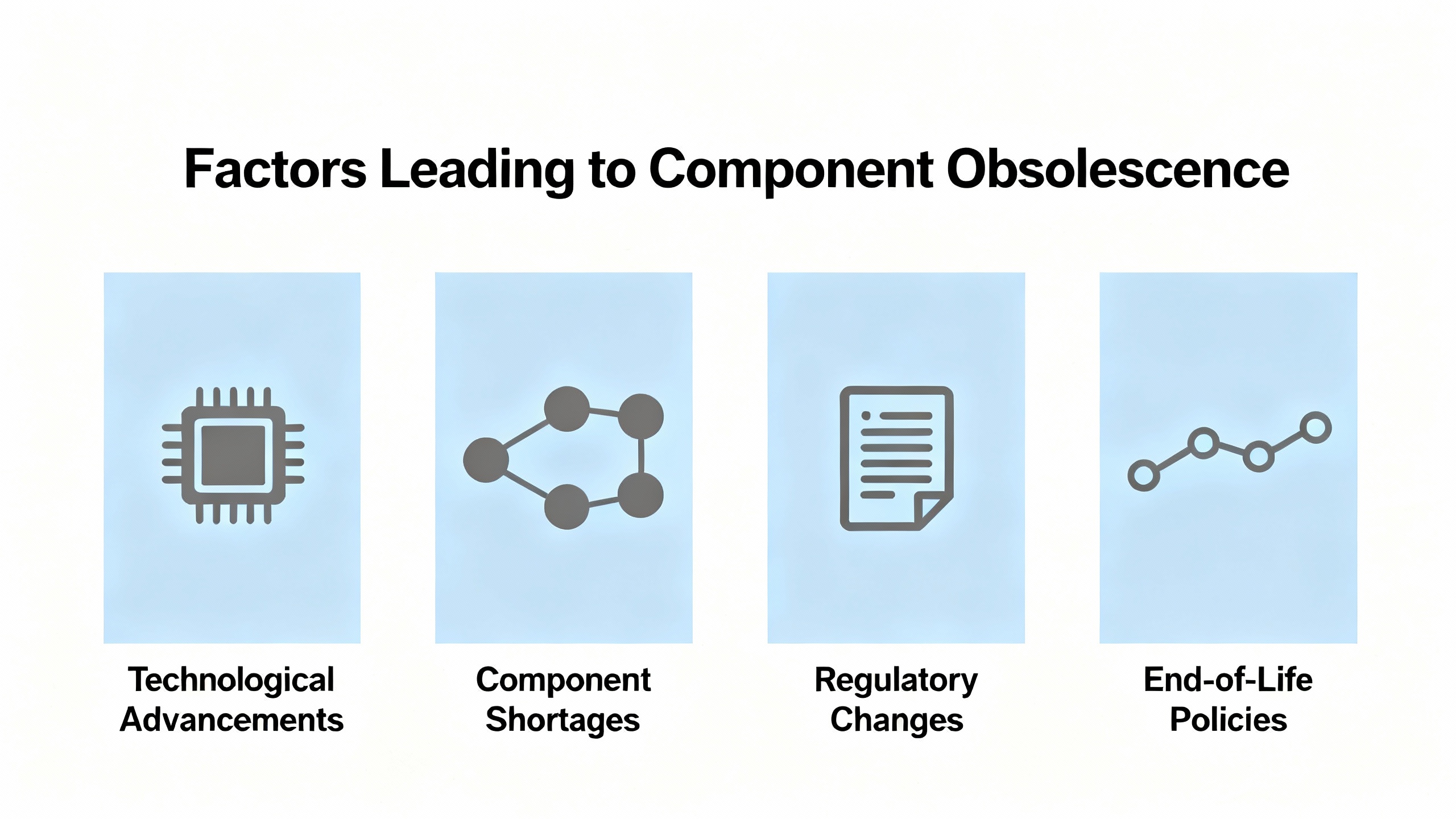
Product obsolescence is not a Schneider-specific quirk; it is a function of electronics as an industry. A Schneider-focused article from 999automation explains the dynamic clearly. Equipment manufacturers continuously improve designs to be faster, smaller, and more cost effective. Meanwhile, semiconductor and component vendors retire older-technology parts as new processes and packages take over. When a key component disappears from the supply chain, the product that relies on it eventually has to be redesigned or discontinued. There is no way around it.
That is why you see classic Modicon hardware age out even when it is still performing well in the field. The internal components that made those PLCs and drives possible simply are no longer manufactured. As an integrator, I have seen more than one “perfectly good” legacy rack become unsupported overnight because a single ASIC hit end of production.
Regulations and RoHS-driven redesigns
Regulation is the other big driver. In Europe, Directive 2002/95/EC (better known as RoHS) came into force in 2006 and restricts the use of six hazardous substances in electrical and electronic equipment: lead, mercury, cadmium, hexavalent chromium, and two classes of brominated flame retardants (PBB and PBDE). That forced a wholesale move from traditional lead-based solder to lead‑free alloys and changed how boards are manufactured.
The 999automation article notes that regulatory compliance and technological evolution together are key reasons older Schneider products must be replaced with updated equivalents. Even if a legacy Modicon module still runs flawlessly, a RoHS-noncompliant design cannot be sold into regulated markets. Schneider and its distributors responded by maintaining RoHS-compliant ranges and, in the case of 999automation, committing that all equipment supplied meets RoHS requirements.
Software and firmware lifecycles
On the software side, Schneider Electric’s published End of Life policy for software and firmware makes it clear that code has a lifecycle just like hardware. The policy defines versioning using an X.Y.Z convention, where X is the platform version, Y is the major version, and Z is the minor version. Two milestones matter in practice.
The End of Version date is when Schneider stops licensing a particular software version, even though newer versions of the same product continue to be sold. The End of Life date is when Schneider stops software maintenance, installation and configuration assistance, and other support for that version. Patches may remain downloadable for a limited “reasonable” period, at Schneider’s discretion, but there is no ongoing engineering work on that branch.
Standard support generally covers the current platform and the previous two major versions. In other words, if you want Schneider to fix issues, you should plan to be on relatively recent major versions. The policy also notes that Schneider typically provides at least 90 days’ notice before an End of Version date and posts notices on its EcoStruxure IT help center, but each product line can be treated independently and the policy itself may change without notice.
Guillevin Automation, in a Mechatronics Canada article, gives a similar picture for control hardware. A “legacy control system” is defined as one that is no longer supported by the manufacturer, and typical hardware support windows are on the order of 25 to 30 years. Products pass through stages such as active, active mature, end of life, and finally obsolete. Once obsolete, there is no guarantee that replacements exist, and any remaining stock is scarce and tends to command premium pricing.
What “obsolete” looks like in the Schneider Modicon world
Concrete examples from EcoStruxure Machine Expert
Schneider’s terminology becomes very real when you open an existing project in EcoStruxure Machine Expert and see “Obsolete Devices” in the update dialog. Schneider’s Machine Expert documentation lists devices that are no longer supported by the current version and, where possible, proposes conversion targets. If there is no recommended replacement, the conversion column is blank.
A few examples illustrate how this plays out.
| Obsolete device family | Recommended replacement | Notes |
|---|---|---|
| Modicon TM238 logic controllers | Modicon TM241 and TM241CEC controllers | TM238LDA, LDD, LFAC, and LFDC variants migrate to various TM241C and TM241CEC models, moving projects to newer logic platforms. |
| Altivar ATV32 drives | Altivar ATV320 | ATV32 is declared obsolete and converted to the ATV320 family for continued support. |
| Altivar ATV31 and ATV312 drives | Altivar ATV320 | Legacy general-purpose drives mapped to the ATV320 series. |
| Altivar ATV71 (220 V and 400 V) | Altivar ATV340 or ATV930 | Higher-performance replacement drives for common voltage ranges. |
| Altivar ATV71 (690 Vac) | Altivar ATV930 | High-voltage variants migrate to ATV930. |
| Harmony HMISTO monochrome HMIs | Harmony HMIS5T | Monochrome terminals replaced with modern Harmony HMIS units. |
| Various Harmony HMIXBT graphic HMIs | Harmony HMIGTO and HMIGTU | Older HMI families migrate to newer Harmony HMI platforms, sometimes via HMIG3U boxes. |
| OTB remote I/O islands | TM3 bus couplers plus TM3 digital I/O modules | OTB1E0, OTB1S0, and OTB1C0 models convert to combinations of TM3 communication modules and TM3DM I/O, typically in TM221 or TM241 architectures. |
Other devices in the list, such as ATV‑IMC motion controllers, Lexium05 and Lexium23+ drives, certain Osicoder encoders, various power meters, and several HMI backplane products, have no direct replacement in the current Machine Expert version. When you see a dash in the “Converted to” column, it means the engineering work will be a custom redesign rather than a simple part swap.
The same documentation warns that conversion can affect addressing and libraries. It explicitly advises engineers to avoid direct physical addresses where possible, to back up projects before conversion, and to verify that new devices support all required functions and communication ports. There is a clear safety warning: after conversion, you are expected to confirm that direct addresses, such as %IB5, have been translated correctly and that the modified project still provides the intended functionality. Schneider ties this directly to avoiding unintended equipment operation that could result in serious injury or equipment damage.
From classic Modicon PLCs to the M580 ePAC
On the PLC side, Schneider has invested heavily in backward-compatible migration paths. An article on RS DesignSpark describes the evolution from PLCs to PACs and then to the Modicon M580 “ePAC,” which uses an Ethernet-based, cyber-secure backplane designed for modern data throughput and IT/OT integration.
The same article notes that Schneider’s Unity Pro environment supports all five IEC 61131‑3 programming languages plus a sixth LL984 editor. That LL984 editor allows applications originally created on 1980s DOS‑based Modicon PLCs to be brought forward onto current M580 hardware, preserving old but proven control logic while gaining modern networking, diagnostics, and security.
The M580 roadmap described there offers three main migration paths. In the lightest-touch scenario, you change only the CPU and software, keeping the racks, I/O modules, and field wiring. In the next level, you replace the CPU, software, racks, and modules but retain existing field wiring. The most aggressive path is a complete system replacement. In practice, most plants I work with choose some variant of the first two options, because they materially lower risk and outage time compared with a full demolition.
The risks of running on discontinued Modicon hardware
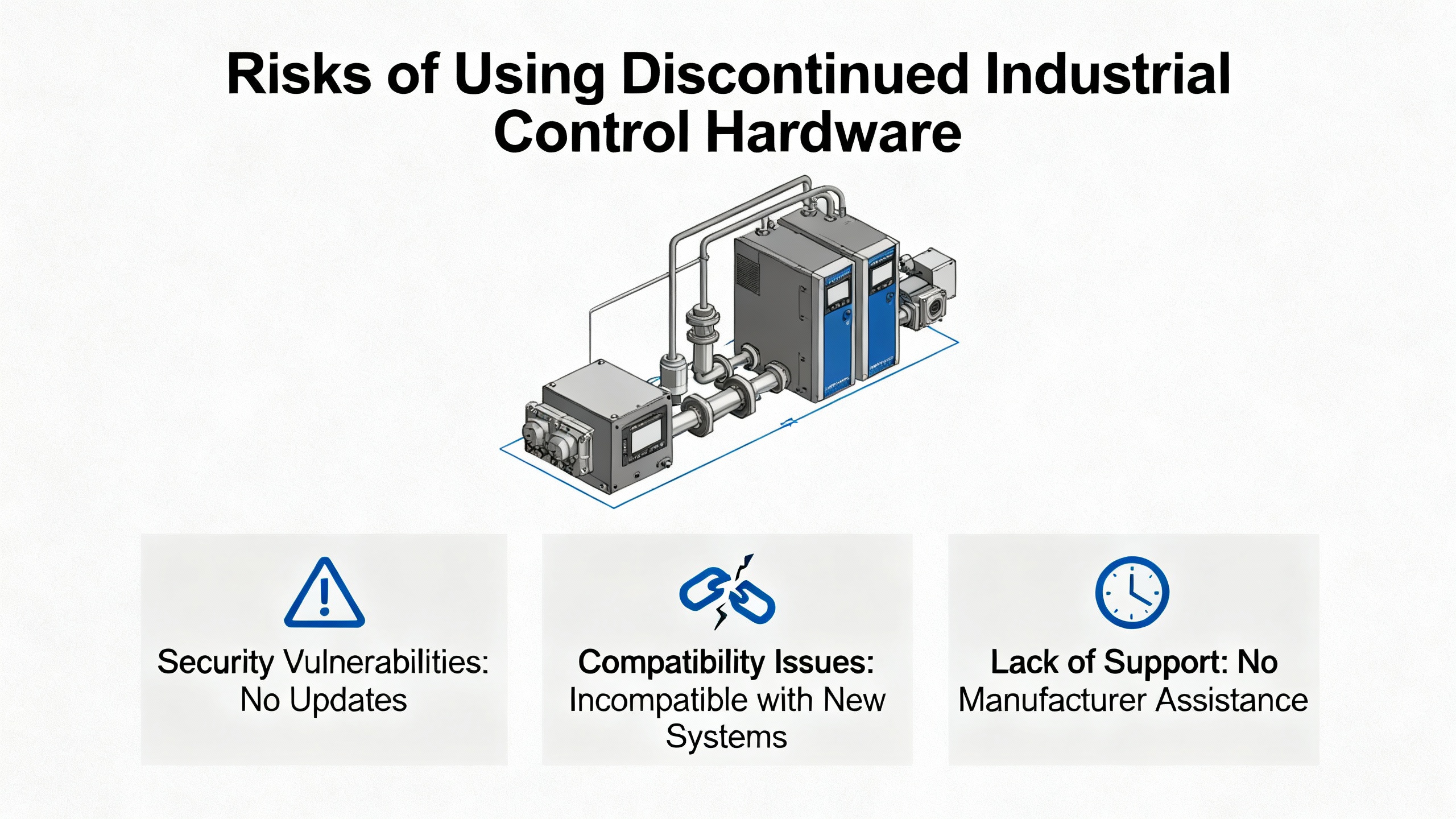
Keeping a legacy Modicon system running “as is” can feel like the safest option, especially when the plant is hitting production targets. However, the risks accumulate slowly.
RT Engineering outlines the typical pattern for aging industrial control systems. Hardware and software become obsolete: vendor support ends, compatible programming tools disappear, and spare parts are scarce or only available on secondary markets. Physical degradation sets in as corrosion, heat, and vibration loosen terminal blocks, crack insulation, and wear out relays and contactors. Communications fall behind; legacy protocols such as RS‑232 or proprietary fieldbuses make it difficult to integrate smart devices, modern SCADA, or IIoT platforms that expect Ethernet-based communications.
Documentation and know‑how are often the first casualties. As experienced technicians retire, programs, schematics, and settings are not always preserved or updated. Troubleshooting becomes a detective exercise based on old drawings and “tribal knowledge.” Diagnostics are limited, so failures manifest as nuisance trips, unexplained resets, and hours of downtime chasing intermittent faults.
Safety is a serious concern. RT Engineering points out that industrial control systems installed 15 to 25 years ago frequently do not meet current safety standards such as OSHA, NFPA 70E, or ISO 13849. Common issues include inadequate emergency stop circuits, missing safety relays, and unlabeled wiring. Combined with obsolete hardware, these deficiencies increase both incident risk and regulatory exposure.
From a purely financial perspective, multiple sources highlight the same pattern. Maintenance and parts costs rise as components approach obsolescence. Hasuka Automation describes challenges such as long overseas lead times, inflated prices, and counterfeit or dead‑on‑arrival parts. Industrial Electrical Warehouse and Industrial Automation Co. both note that engineers end up relying on surplus and third‑party channels to keep legacy systems alive, with varying levels of quality and traceability. The net effect is higher downtime, higher operating cost, and more operational uncertainty.
That does not mean you should rip out every legacy Modicon system tomorrow. It does mean you should treat discontinued parts as a managed risk, not an afterthought.
A practical support strategy for legacy Modicon systems
Step 1: Build real lifecycle intelligence for your installed base
The best way to deal with discontinued Modicon parts is to see them coming. Industrial Automation Co. recommends starting with a thorough audit of your production assets. In practice, that means creating an inventory that captures more than just a PLC nameplate. At a minimum, record part numbers, serial numbers, firmware or software versions, installation dates, maintenance history, and—where available—manufacturer lifecycle data such as typical service life.
Once the inventory exists, classify components by risk. High‑risk items are those with no obvious alternatives and a big process impact, such as main PLC CPUs, key remote I/O islands, or specialist servo drives. Lower‑risk items might have drop‑in replacements or easy retrofit options. Industrial Automation Co. explicitly recommends categorizing by risk level and training maintenance staff to recognize early signs of failure, such as unusual error codes or performance drift.
You should also watch the vendor side. Schneider’s End of Life policy encourages customers to monitor the EcoStruxure IT help center for End of Version and End of Life notices. Manufacturers like Schneider often publish lifecycle status labels such as “active,” “active mature,” “end of life,” and “obsolete,” as described by Guillevin. Keeping a simple register of which Modicon product families you rely on, and where they sit in that lifecycle, lets you plan upgrades or stockpiling before a disruption forces your hand.
Industrial Electrical Warehouse recommends formalizing this into an obsolescence management plan. That plan tracks aging components and their production status, identifies which need proactive spares, and prevents last‑minute scrambles when a critical device suddenly fails and is no longer manufactured.
Step 2: Use the right channels to source discontinued Modicon parts
When a part is already discontinued, where you buy from matters as much as what you buy.
On the OEM side, Schneider Electric offers structured spare parts management and industrial repair services. Schneider’s spare parts management services focus on genuine parts that fit precisely with existing electrical distribution and control equipment. They position spare parts management as a way to improve asset management, maximize uptime, and support sustainability. The EcoStruxure Service Plans portfolio combines the EcoStruxure digital platform with remote and on‑site consultancy, using condition‑based maintenance rather than purely reactive replacement. These plans can include spare parts strategies tuned to the criticality and condition of specific assets.
Schneider’s Industrial Repair Services extend this ecosystem. Their buy, sell, and exchange program for industrial electronics includes an Advance Exchange option for Schneider brands: customers receive a new or refurbished unit immediately, then return the defective part within a specified period (typically 45 days) to receive credit down to the exchange price. Schneider also stocks remanufactured items from other major brands such as Allen‑Bradley, GE, Siemens, and Texas Instruments, backed by a one‑year warranty. When a needed item is not in stock, Schneider leverages an extended supplier and partner network to locate it. They also purchase surplus inventory, allowing plants to monetize removed or excess equipment.
For motor control centers, Schneider’s modernization and upgrade offerings illustrate another angle. Rather than replacing an entire low‑voltage MCC lineup, Schneider can supply direct replacement units that fit into existing structures from multiple OEMs, including legacy Square D and third‑party centers. When direct replacements are not available, Schneider can retrofit genuine MCC buckets with new components. In both cases, they encourage upgrading to intelligent motor control centers using TeSys T motor management systems or variable frequency drive units. The key principle carries over to Modicon environments: reuse infrastructure where you can, but modernize the intelligence and protection.
Specialist third‑party suppliers play a complementary role, especially when official channels no longer carry a particular Modicon part. The Industrial Automation Co. article emphasizes partnering with distributors who focus on obsolete and hard‑to‑find automation components. Industrial Automation Co. backs most products with multi‑point functional testing and warranties up to 24 months, and they highlight the importance of cross‑referencing parts, suggesting compatible upgrades, and offering technical support.
Hasuka Automation makes similar points from a European perspective. They focus on obsolete PLCs, HMIs, and sensors with strong testing and warranty practices and maintain a global sourcing network for parts that are not on the shelf. They stress the need to verify real‑time stock, confirm testing and refurbishment status, and request photos, datasheets, and condition reports before purchase, given the risk of counterfeit or dead‑on‑arrival parts.
Industrial Electrical Warehouse concentrates on legacy electrical and control components. They stress cross‑reference guides to identify form‑fit‑function replacements, surplus inventories as a source of discontinued parts, and retrofit solutions when direct replacements no longer exist. Their positioning includes a counterfeit‑free guarantee based on sourcing from trusted channels.
Classic Automation’s Modicon PLC catalog demonstrates the breadth of the aftermarket ecosystem. It lists Modicon‑related parts from a wide range of manufacturers, with some brands such as GE General Electric represented by nearly two thousand distinct items and others supplying narrower, more specialized ranges. The picture that emerges is clear: the Modicon installed base is large enough that multiple vendors maintain inventories and expertise specifically aimed at supporting it.
Surplus and asset recovery programs are not just a sourcing channel; they are also a way to turn your own storeroom into an asset. Industrial Automation Co. runs buyback programs for drives, amplifiers, and modules. Schneider’s repair services purchase surplus industrial electronics. If you standardize on a new Modicon platform and retire older devices, those programs can help fund the upgrade while keeping usable legacy hardware in circulation for other plants.
Step 3: Engineer migration paths, not just part swaps
Sourcing the last available module can get you through the next shutdown, but it does not solve the structural problem. A serious support strategy for discontinued Modicon parts needs a migration plan.
Control Engineering describes three basic strategies for dealing with obsolete PLCs. The first is to keep the legacy system as‑is, accepting rising risk and limited support in exchange for minimal capital cost now. The second is to rewrite the control code from scratch on a new platform, which can remove decades of undocumented patches but risks missing subtle behaviors and demands extensive validation. The third option is to migrate existing code into new hardware and software, preserving proven logic while moving to supported platforms. The article favors the third path in many real‑world cases, especially when coupled with thorough analysis of how the process works mechanically and programmatically.
A Schneider‑centric, stepwise approach is described by RS DesignSpark and Mechatronics Canada. Both argue against a full “rip and replace” except in rare cases. In a 24/7 plant, shutting everything down to rewire an entire control system is often not practical and introduces many unknowns. A phased migration—processor and network now, I/O and field wiring later—is usually safer.
Vendors support these strategies with hardware and software tools. Control Engineering notes that major PLC vendors provide hardware migration kits such as wiring harnesses that adapt legacy terminal blocks to new I/O modules. Mechatronics Canada highlights Weidmüller migration kits that use marshalling cables and rack‑type systems to connect old I/O terminal blocks to new controllers without pulling and reterminating wires. They offer both in‑rack solutions, where the new controller sits on top of old wiring arms, and bridge solutions, where marshalling cables route signals to a new panel location when space in the original enclosure is limited.
On the software side, Schneider offers conversion tools that pre‑convert legacy programs, including those from other vendors, into newer platforms. According to the Mechatronics article, these tools can estimate the percentage of logic successfully converted—such as 90 or 100 percent—and help integrators focus on unconventional or unsupported code blocks. Control Engineering describes similar tools from major PLC suppliers, which translate most logic automatically but still require engineer review for things like peer‑to‑peer messaging, analog scaling, and PID behavior, where differences between platforms can be significant.
From a Modicon perspective, the combination of the Unity Pro LL984 editor and M580 migration options gives a structured way to bring very old applications forward. In my own projects, the most successful Modicon migrations have followed a pattern: audit the existing system, convert and test programs offline, use wiring adapters or marshalling solutions to keep field terminations intact, and then cut over one controller or one subsystem at a time with full testing and rollback plans.
Safety and validation are non‑negotiable throughout this process. Schneider’s EcoStruxure Machine Expert warning about unintended equipment operation after device conversion is explicit: you must verify that replacement devices support all required functions and communication ports, confirm that any direct addresses have been translated correctly, and back up the project before making changes. RT Engineering’s observations on outdated safety circuits in legacy panels reinforce that migrations are an opportunity to bring systems into alignment with current safety standards, not just to update electronics.
Step 4: Design a spare parts and support model for the next decade
Too many plants treat spare parts for legacy Modicon systems as an annual shopping list instead of a long‑term strategy. The better approach is to design a spare parts model that aligns with your risk profile and the lifecycle curves of your key assets.
Multiple sources converge on similar practices. Industrial Automation Co. recommends identifying mission‑critical components—PLCs, VFDs, HMIs, servo drives—and understanding their lifecycle stages. Hasuka Automation emphasizes confirming exact part numbers, revisions, and series so you can stock the right items and identify compatible alternatives. Industrial Electrical Warehouse advocates implementing an obsolescence management plan that keeps a registry of aging components and their production status.
The automotive aftermarket analysis by Scube Marketing, although focused on vehicles rather than industrial controls, offers a useful conceptual framework that carries over. They distinguish between just‑in‑time ordering for high‑volume, readily available parts, safety stock building for critical components at risk of discontinuation, supplier diversification when there are multiple viable sources, and last‑time buys for parts confirmed as discontinued but with ongoing demand. Each strategy has a cost profile: just‑in‑time minimizes carrying cost but increases vulnerability to supply shocks, safety stocks raise inventory investment but reduce downtime risk, and last‑time buys require large upfront capital but can be justified for truly irreplaceable parts.
Applied to Modicon systems, the general principle is straightforward. For noncritical, easily replaceable items, lean inventory is acceptable. For high‑risk, obsolete Modicon CPUs, remote I/O racks, specialty communication modules, or key drives, you should consider holding dedicated spares or at least having a verified, tested sourcing path through a trusted supplier. Schneider’s spare parts management services and EcoStruxure Service Plans can formalize this into condition‑based strategies, where parts are replaced based on equipment condition and criticality rather than arbitrary time intervals.
Comparing options: keep, selectively modernize, or migrate
At some point, every plant with a legacy Modicon footprint faces a strategic choice. You can keep the existing system running as long as possible, selectively modernize around it, or commit to a structured migration. None of these options is free of tradeoffs.
The “keep it running” approach minimizes capital cost in the short term and leverages equipment that operators know well. For lightly used or noncritical systems, it can be a rational choice. The downside is steadily increasing risk: limited spare‑parts availability, unsupported software, potential safety gaps, and growing reliance on a shrinking group of people who truly understand the system.
Selective modernization—upgrading drives, HMIs, and networking while leaving the core PLC platform in place—often delivers a good balance. Schneider’s MCC modernization and Modicon M580 migration paths are designed with this in mind. You can gain energy efficiency with newer Altivar drives, improve operator visibility with Harmony HMIs, and enhance connectivity with Ethernet‑based architectures, all while keeping the original field wiring and much of the existing logic. This approach requires careful engineering and testing but typically offers strong return on investment and manageable outage windows.
Full migration to a new platform is the cleanest long‑term answer but has the highest up‑front cost and the greatest risk if not handled carefully. Here, the techniques from Control Engineering, RS DesignSpark, and Mechatronics Canada become essential: pre‑conversion of programs, hardware migration kits, marshalling solutions, stepwise cutovers, and robust rollback plans. When executed well, a migration can be performed in small chunks, as demonstrated in water and wastewater case studies where integrators cut over roughly one PLC per day with limited physical change time and extended software testing.
There is no one‑size‑fits‑all prescription, but the wrong answer is to drift without a plan. Discontinued Modicon parts are a signal, not a surprise, if you are watching lifecycle data.
FAQ: Legacy Modicon support and discontinued parts
Can I safely keep running a Modicon system if key parts are obsolete?
In many cases, yes, provided you understand and manage the risk. Several sources, including RT Engineering, point out that control systems can continue operating long after their formal service life, but the risk of failure, lack of vendor support, and safety gaps increases over time. If you choose to keep running, you should at least audit the system, identify high‑risk components, secure tested spares from reputable sources, and document programs and wiring thoroughly. You should also evaluate safety circuits against current standards and use planned shutdowns to address obvious weaknesses.
How long will Schneider support my Modicon software and firmware?
Schneider’s End of Life policy for software and firmware describes support in terms of platform and major versions. Standard software support generally covers the current platform or major version and the previous two major versions, with issues typically resolved only in the latest releases. End of Version marks the end of licensing for a specific version, while End of Life marks the end of maintenance and support. Schneider typically provides at least 90 days’ notice before End of Version and posts notices on its help center, but exact timelines and exceptions are decided product by product. For firmware management tools that do not require support contracts, Schneider notes that support is available for one year after purchase.
Is it better to stockpile discontinued Modicon parts or invest in a migration?
That decision depends on your risk tolerance, budget, and production profile. A limited stockpile of critical, hard‑to‑replace Modicon parts can buy you years of breathing room at relatively modest cost, particularly if acquired through reputable channels with documented testing and warranties, as advocated by Industrial Automation Co. and Hasuka Automation. However, stockpiling does not change the underlying obsolescence of the platform. At some point, you will face the same migration questions, but under more pressure. In contrast, a planned migration or phased modernization demands more upfront engineering and capital but can reduce long‑term downtime risk, improve safety, and align your plant with Industry 4.0 requirements for connectivity and cybersecurity. In my experience, the best results often come from a hybrid approach: modest strategic spares combined with a staged modernization roadmap.
Closing
Discontinued Schneider Modicon parts are not the end of the road for your legacy systems. They are a reminder that even the most reliable control platforms live within a wider ecosystem of components, regulations, and software lifecycles. With disciplined asset intelligence, carefully chosen suppliers, Schneider’s own migration and spare‑parts programs, and a pragmatic modernization plan, you can keep legacy Modicon systems supporting your plant for years while you prepare the next generation of control architecture. As a systems integrator and project partner, my advice is simple: treat obsolescence as an engineering problem you can plan for, not a crisis you have to react to.
References
- https://www.plctalk.net/forums/threads/fyi-modicon-984-and-800-series-i-o-hardware-officially-obsolete.27884/
- https://www.controleng.com/migrating-legacy-plc-programs-to-modern-plc-hardware/
- https://www.rs-online.com/designspark/stepwise-approach-to-upgrading-your-old-control-system
- https://www.rteng.com/blog/common-issues-with-aging-industrial-control-systems
- https://www.schneiderelectricrepair.com/buy-sell-exchange-industrial-electronics/
- https://www.scubemarketing.com/blog/strategies-handling-discontinued-obsolete-automotive-parts
- https://cedbayarea.com/wp-content/uploads/Upgrading-Your-Switchgear-is-Easy.pdf
- https://www.classicautomation.com/parts/modicon/modicon-modicon-plc?srsltid=AfmBOor77DplJHJw315szmkvFVG0d3SpbCZSopgXeqWhf_oOeJml1hi_
- https://www.hasukaautomation.co.uk/blogs/news/how-to-source-obsolete-automation-parts-without-the-hassle?srsltid=AfmBOoozmzhg8wojJM6glewloLoJLbD6BcB7ykaIUWoP9G933FM4kTNV
- https://media.distributordatasolutions.com/228/schneider_synd_json/c30c501390e9b77f3e053fb8a74a8e8509955fc0.pdf
Keep your system in play!
Top Media Coverage
Categories

Related articles Browse All
-
 BlogImplementing Vision Systems for Industrial Robots: Enhancing Precision and Automation2025-08-12 11:26:54Industrial robots gain powerful new abilities through vision systems. These systems give robots the sense of sight, so they can understand and react to what is around them. So, robots can perform complex tasks with greater accuracy and flexibility. Automation in manufacturing reaches a new level of ...
 -
 BlogOptimizing PM Schedules Data-Driven Approaches to Preventative Maintenance2025-08-21 18:08:33Moving away from fixed maintenance schedules is a significant operational shift. Companies now use data to guide their maintenance efforts. This change leads to greater efficiency and equipment reliability. The goal is to perform the right task at the right time, based on real information, not just ...
 -
 BlogThe Evolution of Steam Turbine Control Systems2026-03-31 08:33:35CALL US:+86-18020776786 | E-MAIL:INFO@AMIKON.CN In-depth analysis of the GE Mark VIe control system Mark VIe: A Modern Mainstay for Industry 4.0 Mark VIe's core concepts are "high availability, open connectivity, and intelligent readiness." It utilizes comm...


- Q&A
- Policies How to order Part status information Shipping Method Return Policy Warranty Policy Payment Terms Email Marketing Policy VAT and Import Information
- Asset Recovery
- We Buy Your Equipment. Industry Cases Amikong News Technical Resources Why choose us FAQs
- Registered Address
-
32D Guomao Building, No.388, Hubin south Road, Siming district, Xiamen,Fujian, China

Leave Your Comment