
-
Please try to be as accurate as possible with your search.
-
We can quote you on 1000s of specialist parts, even if they are not listed on our website.
-
We can't find any results for “”.
Fast Delivery Automation Components: Quick Turnaround for Critical Needs
When a production line is down, the clock is not your friend. I have spent enough nights on factory floors and at distribution docks to know the difference between a smooth recovery and a costly scramble often comes down to one thing: how fast you can source, ship, and install the right automation components. The good news is that the same technologies we deploy to optimize warehouses and last‑mile delivery can be harnessed to deliver industrial hardware with speed and confidence. The real trick is blending solid engineering judgment with a disciplined, automation‑enabled supply chain.
This article outlines how to design a fast‑turn component pipeline without sacrificing safety, compliance, or maintainability. It draws on field experience from systems integration projects and corroborates practices discussed by sources such as Box, Convergix Automation, Interlake Mecalux, QuickBooks, SmartRoutes, Arrivy, Atlassian, Workato, and others. Along the way, I will translate logistics and process‑automation lessons into pragmatic tactics for getting PLCs, drives, HMIs, sensors, and safety devices where they need to be, when every hour counts.
What “Fast Delivery” Means for Automation Hardware
In industrial automation, speed is only valuable if it is reliable. The requirement is not just to move a package quickly; it is to deliver the exact component revision, firmware level, and accessories that can be commissioned on arrival. Last mile is notoriously unpredictable due to weather, traffic, and breakdowns, which is why the final leg has become the focal point of customer expectations and operational risk, as highlighted by Convergix Automation. The bar set by leaders that normalize same‑day delivery and real‑time tracking has migrated into B2B expectations. For plants, this is doubly true during unplanned downtime and tight outage windows.
The backbone of fast hardware delivery is process discipline upstream. Business process automation (BPA) and robotic process automation (RPA) remove friction across quoting, approvals, documentation, and shipping. Box frames BPA as the orchestration layer that ties together tasks and workflows, with RPA handling repeatable steps. The combination reduces touches, error risk, and time‑to‑dock. A Box‑sponsored IDC analysis emphasizes data quality and metadata as prerequisites; in my experience, metadata is what separates a perfect overnight shipment from a box that sits on a bench because the wrong fieldbus adaptor or cable ended up inside.
From Order to Dock: The Automation Behind Quick Turnaround
BPA has moved from theory to mainstream practice. Box points to a measurable shift, with operational excellence prioritized in industry surveys and a strong majority planning to increase automation investment according to The State of Process Orchestration 2024. Gartner expects a sizable share of enterprise network activities to be automated by 2026. On the ground, these trends translate into shorter internal cycle times and more consistent outcomes for emergency hardware orders.
You get there by addressing three realities. First, identify and prioritize the high‑volume, time‑consuming manual steps in your order‑to‑ship process, then set simple outcome metrics like turnaround time and first‑attempt accuracy. Second, standardize data and metadata across ERP, WMS, and ticketing; Box’s research calls out unstructured, siloed data as a bottleneck, which matches what I see when parts sit while teams chase missing approvals or spec sheets. Third, select tools with straightforward UI, strong APIs, and robust security, and ensure they integrate well with systems you already have. Atlassian’s guidance on BPA alignment and ownership echoes this: define triggers, rules, and responsibilities before you automate.
Warehouse Mechanics That Make “Fast” Real
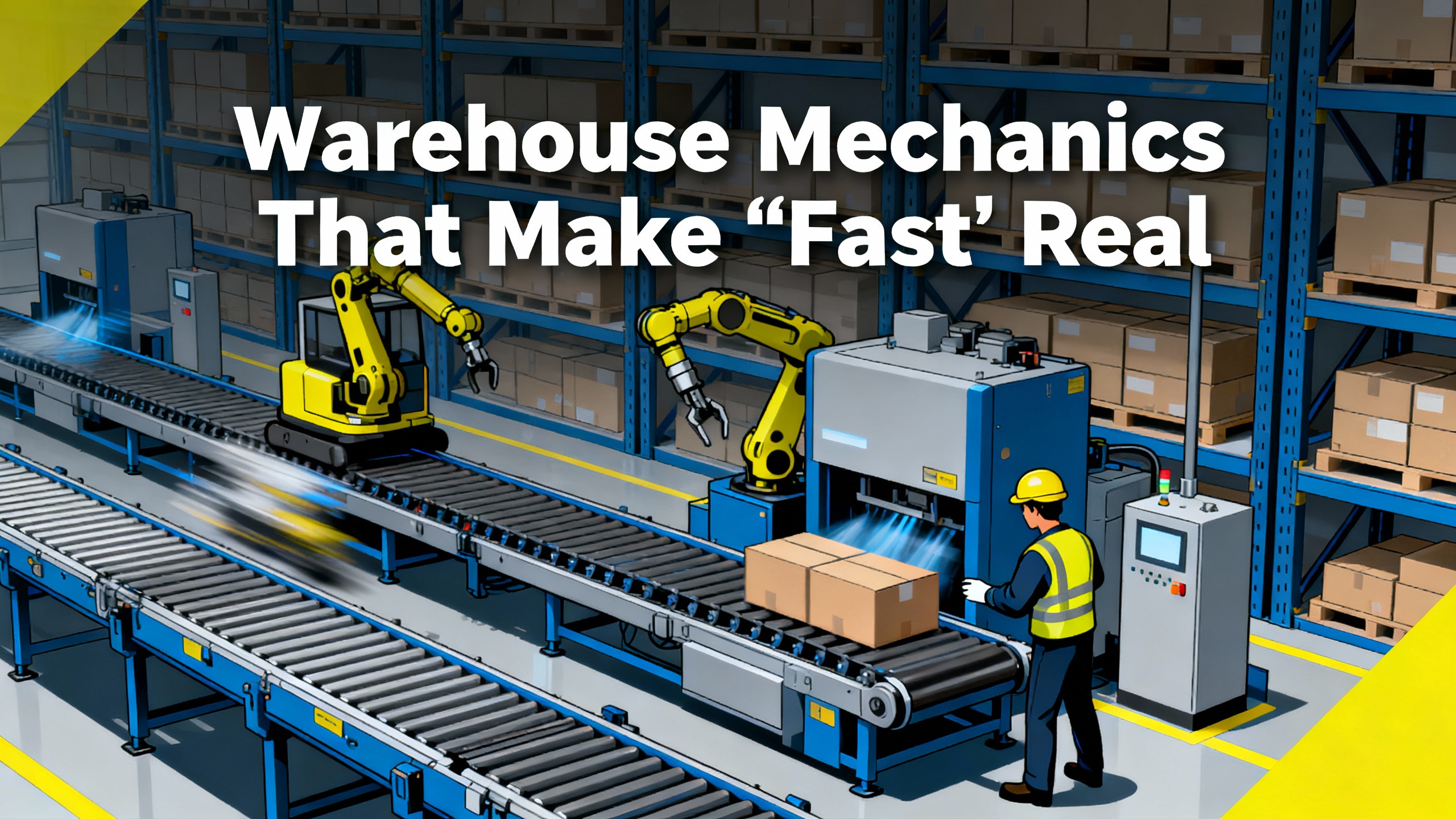
Fast shipping lives or dies in the warehouse. Interlake Mecalux showcases proven patterns: conveyors that compress travel time, automated storage and retrieval systems (AS/RS) for pallets and totes to pack density and speed into the same footprint, miniloads that accelerate small‑parts picking, and goods‑to‑person stations that keep operators working while systems bring the next job. Automatic Truck Loading Systems eliminate minutes at the dock that add up across a shift. A capable Warehouse Management System maintains traceability, enforces pick accuracy, and routes exceptions.
Inbound automation matters more than most teams expect. Automated checkpoints that weigh, gauge, and read barcodes at the door prevent headaches later by catching mis‑labeled or out‑of‑spec items before they are put away. Inbound inspection connected to WMS shortens return loops when suppliers do make mistakes.
Last Mile Under Pressure
Convergix Automation notes that last‑mile automation is an emerging and cost‑effective way to improve reliability as delivery windows stretch into nights, weekends, and holidays. Computer vision accelerates sorting; automation reduces planned stops and, with sensor‑driven predictive maintenance, cuts unplanned downtime. Autonomous options expand operating hours and provide off‑road alternatives that avoid congestion. The e‑commerce spike in 2020 stressed capacity and revealed how fragile manual last‑mile workflows can be under load. Complementary insights from SmartRoutes and Arrivy reinforce practical levers: route optimization, realistic time windows, proactive notifications, and live visibility, all tied to simple KPIs such as on‑time performance, first‑attempt success, order accuracy, time per stop, and capacity utilization. McKinsey research highlights that many customers accept two‑ to three‑day delivery when shipping is free, which reinforces a reliability‑first model for critical parts even when same‑day is not feasible.
The Hardware Reality: Getting Components Right at Speed
Hardware has constraints you cannot abstract away with software. A drive with the wrong horsepower, a PLC with an incompatible fieldbus card, or an HMI with mismatched firmware wastes the speed you gained in logistics. Fast delivery in this domain is about finding the shortest safe path to a working, supported configuration.
Compatibility is often the long pole. When brand substitutions are necessary, plan for interface adapters, protocol gateways, or temporary shims. In my projects, having documented, tested drop‑in alternates for sensors, safety relays, and power supplies—along with the correct connectors and pinouts—has prevented late‑night improvisation. Safety‑rated substitutions require extra diligence; don’t treat them like generic parts. For anything safety‑related, involve your controls engineer and document validations.
Documentation is the invisible accelerator. Box’s emphasis on audit history and e‑signatures is not only about governance; it stops the all‑hands email chains that quietly add days. Keep current manuals, I/O maps, and firmware files alongside the order record. Use templates for return authorizations and installation instructions; your technician in the field should not need to hunt for revision notes while a line is idle.
Pros, Cons, and Tradeoffs of Quick‑Turn Approaches
Pre‑configured kits and standardized panels reduce assembly lead time and simplify commissioning, but they can constrain future flexibility if you lock into a set layout. Multi‑vendor sourcing widens availability and reduces single‑supplier risk, yet increases the burden on compatibility testing and spares planning. Expedited shipping compresses time to site, but without last‑mile orchestration, it can still miss windows or create receiving bottlenecks. Autonomous and predictive capabilities in sorting and routing improve consistency overnight, though they require up‑front integration and training. The art is balancing speed with lifecycle cost and safety.
| Quick‑Turn Tactic | What It Enables | Key Risk | Mitigation Lever |
|---|---|---|---|
| Pre‑configured kits and standard panels | Faster assembly and commissioning | Reduced flexibility for future changes | Maintain a small set of variants tied to common architectures |
| Multi‑vendor alternates on core parts | Wider availability during shortages | Interface and firmware mismatches | Keep tested drop‑in lists with approved adapters and firmware |
| Expedited shipping with live visibility | Shorter order‑to‑dock time | Missed dock windows and reattempts | Use TMS with proactive alerts and realistic time windows |
| Goods‑to‑person and miniloads in DC | Predictable, high‑volume picking | Upfront integration complexity | Start with high‑runner SKUs, expand in phases |
| Autonomous sort/last‑mile pilots | 24/7 operations beyond road congestion | Safety and regulatory limits | Pilot contained routes, expand where reliable |
How to Measure Whether Your Fast‑Delivery Program Works
If you cannot measure it, you cannot improve it. Borrowing from SmartRoutes and Arrivy’s delivery guidance, simple operational metrics apply well to component logistics. On‑time delivery and first‑attempt success tell you whether time promises are credible. Order accuracy, including revision and accessory correctness, is the leading indicator of rework. Average time per stop and dwell time at the dock reveal where to eliminate handling waste. Cost per delivery keeps expedited choices honest. Capacity utilization and out‑of‑route miles expose planning gaps. Tie these to a small dashboard and review after each peak event or outage period.
Buying and Care Tips From the Field
In fast‑turn environments, you do not have the luxury of bespoke engineering on every order. Standardize where it saves time and protect flexibility where it saves you later. Choose a core set of PLC families, drives, and safety devices with verified alternates and keep the documentation tightly maintained. Invest in the small items that derail installs—pre‑terminated cables, glands, adaptors, load reactors, fuses, and contact kits—and bundle them as defaults with the main part. Keep a living “stop‑gap library” of protocol gateways and adapters that let you bridge fieldbuses when vendor substitutions are unavoidable.
Treat metadata like a first‑class part. Capture firmware versions, protocol settings, I/O assignments, enclosure ratings, and mounting footprints in the order object. Box’s focus on metadata management is spot‑on; it makes approvals and handoffs deterministic. Add a simple “install‑ready” checklist to every shipment that confirms environmental ratings, accessories, and configuration files are included. When something does go wrong, make returns painless; Convergix calls out automated pickup and returns as a lever to reduce friction and reverse‑logistics costs. That matters for spare parts programs where fast swap and return is the norm.
The Technology Stack That Unlocks Speed
The technology that accelerates consumer deliveries also accelerates B2B component logistics when it is stitched together deliberately. At the warehouse layer, Interlake Mecalux’s examples show how conveyors, AS/RS, and miniloads create predictable, dense, and fast flows. A WMS, whether a vendor offering or a homegrown system, enforces inventory accuracy and pick optimization. On the transport side, a TMS with dynamic routing and realistic time windows, consistent with routes discussed by SmartRoutes and Arrivy, reduces delays and improves customer communication.
At the process layer, Box Intelligent Content Management with Box Relay templates and audit histories cuts cycle times across quotes, approvals, and compliance checks; Box AI capabilities for summarization and drafting can reduce manual touches while maintaining governance. Workato describes how integration and automation platforms link WMS, TMS, ERP, and service systems so data flows end‑to‑end without swivel‑chair work. Predictive analytics—highlighted by multiple sources—help position stock ahead of peaks and schedule maintenance before a flurry of urgent orders collides with a conveyor outage.
| Tooling Category | Fast‑Delivery Impact | Notes From the Field |
|---|---|---|
| WMS with goods‑to‑person and miniload | Faster small‑parts picking and fewer errors | Start with high‑runner components and expand |
| TMS with live tracking and alerts | Fewer missed windows, better ETA trust | Share links with receiving teams for proactive staging |
| BPA and content management | Faster approvals, fewer email loops | Use templates for quotes, returns, e‑signatures |
| RPA for data entry and status updates | Less manual swivel‑chair work | Good for extracting unstructured docs into systems |
| Predictive analytics | Better pre‑positioning and labor scheduling | Apply to outage seasonality and maintenance windows |
| Autonomous sort and last‑mile pilots | Extended operating hours | Use on low‑risk routes and returns first |

Sustainability Without Sacrificing Speed
Fast can be cleaner. Convergix notes greener delivery from autonomous electric fleets that optimize charging and avoid idling. Research cited by Deloitte points to freight’s growing emissions profile, and MDPI‑cited work suggests combining electric vehicles with AI routing can materially cut emissions. For industrial programs, the practical approach is straightforward: use route optimization to reduce out‑of‑route miles, align deliveries to consolidated windows when possible, electrify shorter runs first, and instrument vehicles and docks to measure and improve.

An Implementation Roadmap You Can Execute
The most reliable fast‑turn programs are iterative. Box advises starting by identifying the most manual, high‑volume, time‑consuming workflows and by setting clear metrics that reflect business outcomes. Fix data early, because messy metadata breaks automation every time. Then pick tools that integrate well, scale with demand, and meet your security and compliance bar. Workato recommends a pilot‑first mindset; Synergy’s best practices reinforce starting small, assigning ownership, training users, and monitoring KPIs continuously. In practice, that looks like selecting a subset of high‑runner SKUs, instrumenting their flow from quote to dock, piloting goods‑to‑person and TMS alerts on that subset, and only then expanding to broader categories and locations.
Real‑World Logistics Practices That Carry Over
Patterns from delivery operations translate directly into industrial components. SmartRoutes and Arrivy emphasize measuring what matters and setting realistic time windows. Convergix encourages piloting automation across sorting, delivery, predictive maintenance, and returns while prioritizing safety and greener options. QuickBooks’ business automation stories make a simple point: integrating core systems speeds handoffs and reduces errors, freeing teams for higher‑value work. Atlassian’s advice to document workflows and rules before automating remains some of the cheapest risk reduction you can buy.
Takeaway
Speed is a system outcome, not a shipping upgrade. In fast‑turn automation hardware, the shortest safe path to a working fix combines upstream process discipline, warehouse and last‑mile automation, pragmatic engineering choices about compatibility and spares, and relentless attention to data quality. When the line is down, the best partner is the one who already did the hard work—clean metadata, tested alternates, pre‑staged kits, integrated WMS and TMS, and a returns loop that does not punish your team for being decisive. The sources cited here converge on the same lesson: start with the workflows that matter, build on good data, and integrate tools that make people faster and more consistent.
FAQ
Which component categories benefit most from quick‑turn programs?
The fastest gains usually come from small‑to‑mid hardware that gums up repairs when it is missing or wrong. Sensors, safety relays, power supplies, low‑horsepower drives, and HMI accessories tend to stall teams more than the marquee items. Keeping pre‑terminated cables, adaptors, fuses, and mounting hardware bundled with the main part reduces rework. For larger assets, standardized panel designs and a small set of verified drive and PLC families help compress assembly and commissioning.
How do I avoid compatibility issues when I must swap brands on short notice?
Treat alternates as a design artifact, not a hope. Maintain an approved list of drop‑in alternates with documented pinouts, footprints, firmware versions, and known good configurations. Keep a small inventory of protocol gateways, adaptors, and fieldbus cards that bridge the most common gaps. Safety substitutions require additional validation; involve controls engineering early and capture test results alongside the work order.
What metrics tell me my fast‑delivery pipeline is actually working?
Focus on outcomes you can explain to operations: on‑time and first‑attempt success, order accuracy including revisions and accessories, average time per stop, dock dwell, and cost per delivery. Add capacity utilization and out‑of‑route miles to improve planning. The goal is to find the smallest set of numbers that change your next action, consistent with delivery metric guidance from SmartRoutes and Arrivy.
Can I speed up delivery and still improve sustainability?
Yes. Route optimization reduces wasted miles, while consolidated windows cut idle time. Where it fits, electrify shorter routes and use predictive maintenance to reduce breakdowns. Convergix highlights the emissions advantages of autonomous electric fleets, and research cited by Deloitte and MDPI indicates that AI‑assisted routing amplifies those gains.
What tools should I prioritize first if I am starting from scratch?
Start where friction is worst. A capable WMS with goods‑to‑person picking for small hardware often pays back quickly. Add a TMS that provides realistic ETAs and live tracking so receiving teams can stage properly. Introduce BPA for quotes, approvals, and returns to reduce internal delays. Integrate these gradually through an automation platform so data flows end‑to‑end, as advised by Box and Workato.
How do returns fit into a fast‑turn component program?
Returns are part of the speed system. If accessory mis‑matches or spec changes happen, a cumbersome returns process will make teams hesitant and slow. Convergix notes that automation can make pickup and returns easy, reducing friction and reverse‑logistics costs. In practice, that means templated RMAs, scheduled pickups from the job site, and a fast credit or replacement loop that restores confidence.
Sources Cited
This article draws on insights from Box, Convergix Automation, Interlake Mecalux, QuickBooks, SmartRoutes, Arrivy, Atlassian, Workato, McKinsey, Deloitte, and MDPI, as well as field experience integrating warehouse and delivery automation with industrial control hardware programs.
References
- https://blog.box.com/how-to-strengthen-your-business-process-automation-strategy
- https://www.codept.de/blog/5-logistics-automation-strategies-you-should-be-aware-of
- https://convergixautomation.com/news-insights/8-ways-automation-is-transforming-last-mile-delivery-96115
- https://eliteextra.com/5-simple-ways-to-implement-logistics-automation/
- https://www.interlakemecalux.com/blog/logistics-process-automation
- https://www.jackcooper.com/logistics-automation-for-smarter-supply-chains/
- https://kes-systems.com/10-best-practices-to-automate-business-processes/
- https://www.podium.com/article/process-automation-best-practices
- https://www.solutionreach.com/blog/6-tips-to-adding-new-processes-automation-to-your-practice
- https://www.stacksync.com/blog/10-essential-strategies-for-successful-business-process-automation
Keep your system in play!


Related articles Browse All
-
 amikong NewsSchneider Electric HMIGTO5310: A Powerful Touchscreen Panel for Industrial Automation2025-08-11 16:24:25Overview of the Schneider Electric HMIGTO5310 The Schneider Electric HMIGTO5310 is a high-performance Magelis GTO touchscreen panel designed for industrial automation and infrastructure applications. With a 10.4" TFT LCD display and 640 x 480 VGA resolution, this HMI delivers crisp, clear visu...
 -
 BlogImplementing Vision Systems for Industrial Robots: Enhancing Precision and Automation2025-08-12 11:26:54Industrial robots gain powerful new abilities through vision systems. These systems give robots the sense of sight, so they can understand and react to what is around them. So, robots can perform complex tasks with greater accuracy and flexibility. Automation in manufacturing reaches a new level of ...
 -
 BlogOptimizing PM Schedules Data-Driven Approaches to Preventative Maintenance2025-08-21 18:08:33Moving away from fixed maintenance schedules is a significant operational shift. Companies now use data to guide their maintenance efforts. This change leads to greater efficiency and equipment reliability. The goal is to perform the right task at the right time, based on real information, not just ...


- Q&A
- Policies How to order Part status information Shipping Method Return Policy Warranty Policy Payment Terms Email Marketing Policy VAT and Import Information
- Asset Recovery
- We Buy Your Equipment. Industry Cases Amikong News Technical Resources Why choose us
- Registered Address
-
32D Guomao Building, No.388, Hubin south Road, Siming district, Xiamen,Fujian, China

Leave Your Comment