
-
Please try to be as accurate as possible with your search.
-
We can quote you on 1000s of specialist parts, even if they are not listed on our website.
-
We can't find any results for “”.
Surplus Schneider PLC Inventory: Excess Schneider Stock Solutions


As a systems integrator who has spent years commissioning and decommissioning lines built around Schneider PLCs, I have seen more than a few pallets of perfectly good controllers and I/O left to gather dust. The irony is familiar: the plant signs off on a modernization project, the new architecture goes live, and the outgoing Schneider hardware quietly turns into “somebody else’s problem” at the back of the warehouse.
From a distance that just looks like spare stock. Up close, it is tied-up capital, rising carrying costs, and eventually a write‑off. The good news is that Schneider PLC surplus is one of the easiest categories of industrial inventory to convert back into cash and risk reduction—if you treat it as a structured asset recovery effort instead of a one‑off clearance exercise.
In this article I will walk through how to define, value, and systematically monetize surplus Schneider PLC inventory, drawing on industrial asset recovery guidance from Automa.Net, inventory best practices from Dean Dorton and Industrial Supply Magazine, and surplus market insight from firms like AX Control, WeSellStocks, and Holland Industrial Group.
What Surplus Schneider PLC Inventory Really Is
Surplus Schneider PLC inventory is not just “old control gear.” In financial terms, it is excess industrial automation stock you hold over and above what you genuinely need to support demand and a reasonable safety stock. Dean Dorton characterizes excess inventory as material that no longer turns at acceptable rates, has fallen in value below its original cost, or is unlikely to be used in the current business model.
Industrial surplus specialists such as AX Control describe surplus automation inventory as a mix of unsold OEM stock (often still sealed in original packaging) and used but viable components removed during upgrades and changeovers. Applied to Schneider automation, that typically means new‑in‑box PLC CPUs, power supplies, communication modules, remote I/O racks, and operator interfaces, plus installed components that were pulled from service during a platform change but still function.
Automa.Net defines industrial asset recovery as a structured process to reclaim value from unneeded automation equipment instead of scrapping or warehousing it. In their guidance, surplus categories explicitly include PLC surplus parts and obsolete automation components from brands such as ABB, Siemens, Schneider, and Omron, as well as drives, control panels, robotics, and long‑tail MRO stock from canceled or completed projects.
Surplus Schneider PLC inventory sits in that intersection: it is technically sound (often) but misaligned with your installed base, your future projects, or your risk appetite. That misalignment is what creates the opportunity.
Why Surplus Schneider PLC Inventory Builds Up
Even well‑run plants end up with Schneider surpluses. The causes are rarely malicious; most are side effects of sensible decisions made in isolation. Several patterns show up again and again.
Modernization and platform changes are the most visible trigger. When production lines are re‑engineered or consolidated, entire Schneider control cabinets can become redundant overnight. Automa.Net notes that asset recovery is often triggered by production line modernization, plant closure, or consolidation. In practice, that might be a site moving to a different control platform, or centralizing production to another facility.
End of product life and OEM lifecycle changes also play a role. When a Schneider product family moves into a late lifecycle phase, the natural reaction in many maintenance teams is to place “just in case” last‑time buys. That risk‑averse instinct is understandable, but without disciplined forecasting and criticality analysis, those buys drift from prudent coverage into permanent surplus.
Forecasting errors and vendor promotions are another common source. Dean Dorton observes that even lean operations accumulate excess inventory through over‑ordering, optimistic demand forecasts, and supplier discounts that encourage doubling an order. Industrial Supply Magazine gives a practical illustration: a vendor offers a discount for doubling an order that you think you can sell over the next year; a customer cancels a big project; now you own double what you can realistically move.
Structural changes in demand and technology accelerate this pattern. WeSellStocks points out that surplus automation gear builds up as technology shifts and certain robots, drives, and controllers become non‑compliant or economically unattractive, even though they still function. ShipBob and Omniful emphasize that the bullwhip effect in supply chains—like the spikes seen during the COVID‑19 period—pushes many businesses to over‑stock “just to be safe,” only to find that demand normalizes quickly and excess stock remains.
The result is predictable: rows of Schneider PLC modules sitting unused while your finance team wonders why so much capital is burned in inventory that never moves.

The Real Cost Of Excess Schneider Stock
Surplus Schneider PLC inventory feels “safe” because it is tangible and technically valuable. From a P&L and balance sheet perspective, it is anything but safe.
Industrial Supply Magazine calls surplus inventory one of the largest costs industrial distributors face. They cite industry analysis showing product overstock and surplus inventory reaching about $350 billion in 1999 and projected to total $445 billion by 2002. NetSuite points out that the combined global cost of overstocks and stockouts was estimated around $1.8 trillion in 2023. This is not a niche issue; it is a structural drag on profitability.
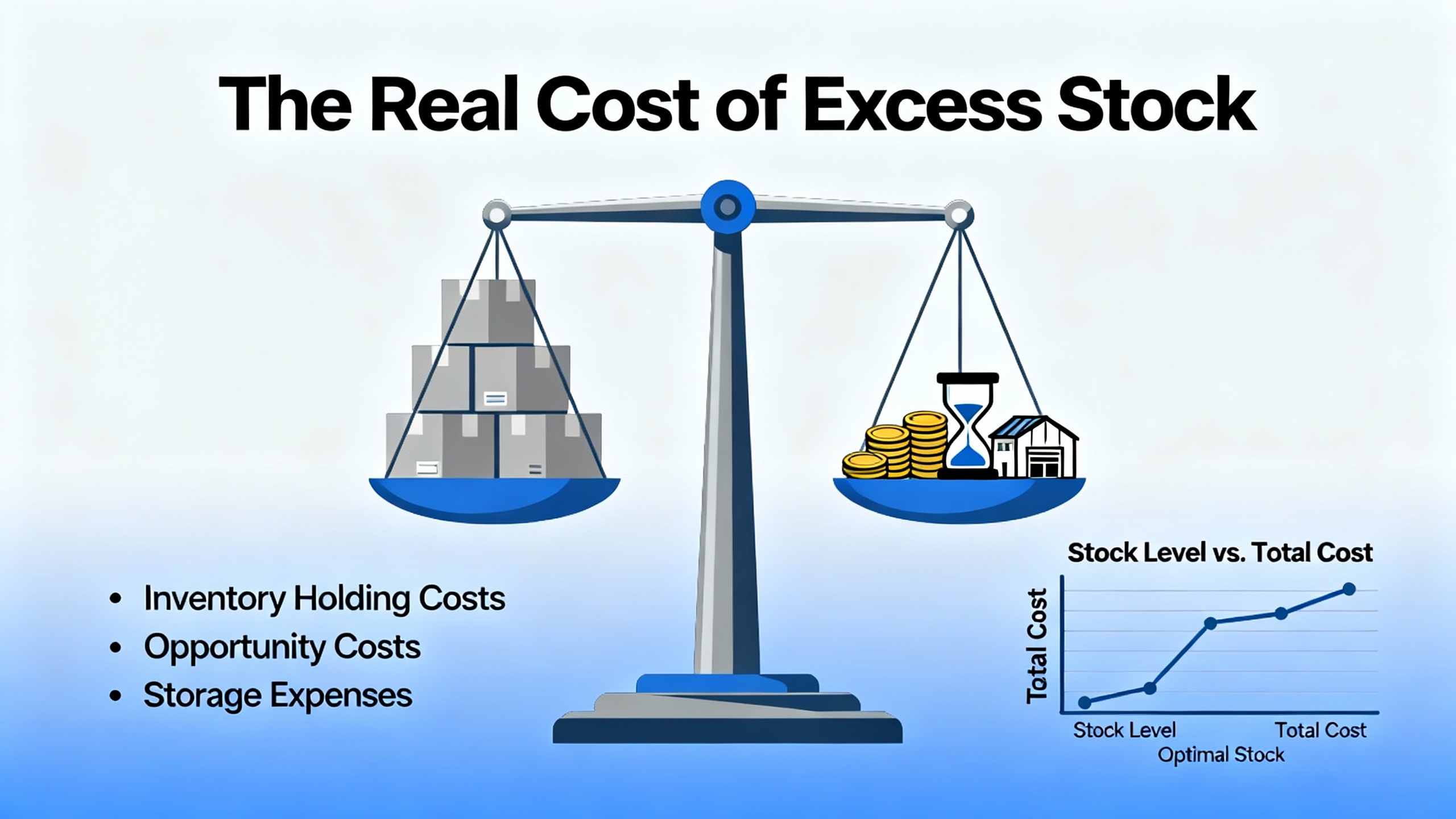
For Schneider PLC assets, you feel that drag in several ways. First comes the cost of capital and carrying. Dean Dorton reminds finance teams that inventory that has fallen below its recoverable value must be written down under “lower of cost or market” rules. Until you take that hit, it quietly consumes working capital, warehouse space, insurance, and handling. ShipBob emphasizes that surplus inventory inflates storage and handling costs, while generating no offsetting revenue.
Second is the opportunity cost. Every cabinet full of unused Schneider automation hardware is space you could be using for fast‑moving spares or new projects. It is also cash that could fund a safety upgrade, a process optimization project, or workforce training. WeSellStocks warns that surplus automation products turn idle assets into a drag on cash flow instead of a source of working capital. In multi‑site environments, the same part often exists as surplus in one plant while being ordered at full price in another.
Third is the risk of obsolescence. ShipBob notes that surplus stock tends to depreciate and eventually become obsolete; Omniful highlights the hidden cost of deadstock write‑offs as products age out of relevance. Even though PLCs age more gracefully than consumer products, the secondary market value of a Schneider module usually moves in one direction over time, especially once an OEM announces limited support windows.
Finally, there is the ESG angle. Automa.Net stresses that asset recovery supports sustainability and circular‑economy goals by extending component lifecycles and avoiding unnecessary new manufacturing. AX Control points out that many industrial components contain hazardous substances such as mercury, lead, and certain flame retardants. Sending pallets of unused Schneider hardware straight to scrap skips a relatively easy win in your environmental and social governance story.
In short, surplus Schneider PLC inventory is both an economic and an environmental liability if left unmanaged—and a genuine asset if you handle it with intent.
Strategic Options For Surplus Schneider PLC Inventory
The good news is that you have more options than “let it sit” or “sell it for pennies.” Drawing on Dean Dorton, Industrial Supply Magazine, Automa.Net, WeSellStocks, AX Control, and Holland Industrial Group, the practical strategies for Schneider PLC surplus fall into a few families: internal redeployment, supplier returns and trades, structured asset recovery through specialists and marketplaces, auctions and liquidation, and finally recycling or donation.
Internal Redeployment And Reuse
Before you sell a Schneider PLC, ask whether another plant or project could use it. Industrial Supply Magazine describes a North American distributor that created an internal surplus removal program so that surplus stock in one location was used to replenish demand in another, rather than triggering new purchases. In my own projects, I have seen significant savings when surplus PLC hardware from a decommissioned line is formally cataloged and approved for use as spares or project stock across a plant network.
This approach works particularly well for standard Schneider modules that are still within OEM support and match your installed base. The trick is to treat redeployment as a structured program, with a coordinator or “surplus czar” as Industrial Supply Magazine suggests, not as informal swapping between maintenance teams. Without central visibility and rules, you simply move the clutter around.
Returns, Credits, And Trades
If your Schneider surplus includes recently purchased material, your first call should be to the original distributor or OEM program where terms allow. Dean Dorton notes that returning inventory for refund or credit is often the best recovery option because it effectively converts dead stock into purchasing power for needed items.
Where returns are not possible, trading inventory with industry partners—even competitors—can have surprising benefits. Dean Dorton highlights trading arrangements as a way to transform unwanted stock into needed items for both parties, while reinforcing relationships. In practice, that might mean swapping surplus Schneider modules for other brands or complementary products you can actually use.
Structured Asset Recovery With Specialists And Marketplaces
Once internal redeployment and returns are exhausted, structured asset recovery is usually the most economical path for Schneider PLC surplus. Automa.Net positions itself as a specialist platform for industrial asset recovery, with three primary models that map well to the Schneider use case.
The first model is outright purchase. In this scenario, a recovery specialist buys your surplus Schneider automation parts in a single transaction. Automa.Net reports that buyout deals typically pay around 3 to 20 percent of market value, depending on condition, packaging, production year, and live demand; the buyer then handles transport and resale. Similar offers are made by surplus buyers like The PLC Depot, which advertises quick, fair market valuations and the option to take payment as cash or in‑store credit toward other PLC equipment. This path is attractive when you need immediate space and cash, and are willing to trade away upside in exchange for speed and simplicity.
The second model is consignment. Here you retain ownership of the Schneider PLC stock, but a specialist such as Automa.Net manages storage, listing, global marketing, pricing, and customer support. They note that consignment can target returns up to about 50 percent of market value, making it well suited to large MRO stocks and long‑tail Schneider items that will sell steadily over time. Dean Dorton describes consignment splits in other industries at around seventy‑five percent to the manufacturer and twenty‑five percent to the distributor, which is a useful benchmark when negotiating fees and responsibilities.
The third model is direct marketplace listing. Automa.Net reports that sellers who list their own stock on a structured marketplace can capture roughly 75 to 85 percent of market value, particularly when bulk upload tools, data enrichment, and price optimization support are available. WeSellStocks describes a similar dynamic for surplus industrial automation products, where specialized marketplaces and auction platforms rapidly match sellers with global buyers and free up floor space. The trade‑off is that you are investing internal effort into cataloging, responding to inquiries, and handling shipping.
AX Control’s experience on the buy‑side of surplus markets adds an important nuance here. They state that buying surplus rather than new can save end users up to about 75 percent off OEM list price, while still providing comparable performance, especially when parts are tested and warrantied. That tells you two things. First, there is strong demand for surplus automation hardware from Schneider and other brands, particularly for discontinued parts. Second, you should not expect to recover anywhere near original list price as a seller; the buyer’s discount is funded from your write‑down.
Auctions And Liquidation
For very large or mixed‑condition Schneider lots, industrial auctions and liquidation can make more sense than item‑by‑item resale. Holland Industrial Group positions industrial auctions as a smart way to dispose of surplus equipment because they bring multiple qualified buyers to you. In one case they describe, CNC machines that private buyers valued at forty to fifty percent of market value sold at auction for eighty to ninety percent, roughly doubling recovery. They also cite research indicating that auctions generally outperform private sales by around fifteen to thirty percent, depending on asset type and market conditions.
Liquidators come into play when speed and simplicity matter more than price. Dean Dorton notes that selling excess inventory in bulk to a liquidator is a lower‑recovery option but helps clear space; UTB Transformers echoes this for electrical equipment, positioning direct purchase programs as a way to convert surplus into cash without managing the sales process. Surplus buyers such as The PLC Depot advertise response commitments within about twenty‑four hours for surplus offers, which illustrates how quickly these channels can move.
Recycling And Donation
Eventually, some Schneider PLC items will fall below any reasonable market value. AX Control and Omniful both stress that scrapping and recycling are last‑resort options, but they are still preferable to landfilling from a sustainability perspective. Some dealers will strip usable components and recycle the rest.
Dean Dorton and ShipBob both emphasize the value of donating certain categories of excess inventory to nonprofit organizations, citing both social impact and potential tax benefits. For Schneider PLC hardware, think in terms of training programs, technical schools, or non‑profit labs where even obsolete controllers can be valuable teaching tools.
Comparing Surplus Strategies For Schneider PLC Stock
Different strategies make sense for different Schneider portfolios. The table below summarizes how common channels line up, using ranges and characteristics reported by Automa.Net, Dean Dorton, Holland Industrial Group, and others. These figures are general industrial patterns, not Schneider‑specific guarantees, but they provide a pragmatic starting point when explaining options to management.
| Channel type | Typical recovery relative to market value | Speed to cash | Internal effort and control | Best suited for |
|---|---|---|---|---|
| Supplier returns or credits | High, often near full purchase value | Medium | Moderate; depends on terms | Recent purchases within return windows |
| Internal redeployment | Implicitly high (avoids new purchases) | Medium | Moderate; requires coordination | Active installed base across multiple plants |
| Outright sale to surplus buyer | Around 3–20% (Automa.Net guidance) | Fast, single transaction | Low internal effort | Mixed lots, urgent space or cash needs |
| Consignment via specialist | Up to about 50% (Automa.Net guidance) | Slower, as items sell | Low to moderate; managed by specialist | Large MRO stocks, long‑tail Schneider PLC and I/O modules |
| Marketplace self‑listing | Roughly 75–85% (Automa.Net guidance) | Variable | High effort but high price control | High‑value, in‑demand Schneider items and teams with sales capacity |
| Industrial auction | Often about 80–90% in good cases (Holland Industrial Group example) | Weeks to roughly a month | Moderate; structured by auctioneer | Large mixed lots, project or site liquidations with deadline pressure |
| Bulk liquidation | Low to moderate | Fast | Low internal effort | End‑of‑life stock where maximizing price is less critical than clearing space |
| Donation or recycling | Minimal direct financial return; possible tax benefit | Variable | Low to moderate; needs documentation | Very slow‑moving, obsolete, or unsellable Schneider automation components |
In practice, a Schneider PLC surplus program will combine several of these channels. The art is in segmenting your stock so that each group flows into the most appropriate path.
Building A Schneider PLC Surplus Strategy That Finance Will Support
A credible strategy for Schneider PLC surplus starts with data, not with a buyer’s phone number. ThoughtSpot defines inventory optimization as managing inventory levels across the supply chain to reduce costs, avoid both stockouts and excess, and improve customer service. Industrial Distribution and Cadre Technologies both stress that without structured methodologies and system support, large MRO inventories turn into an impossible numbers game, leading to both shortages and surpluses.
For Schneider automation hardware, a pragmatic approach usually follows four phases.
The first phase is to get visibility. That means an inventory assessment that goes beyond “PLC parts” and counts actual modules by part number, series, and location, as WeSellStocks recommends for surplus automation products. Automa.Net notes that they use real‑time market data from more than six hundred fifty suppliers to help companies decide which items to liquidate and which to consign; you cannot benefit from that kind of insight unless your own stock list is accurate.
The second phase is to segment and prioritize. Industrial Supply Magazine and ThoughtSpot both advocate ABC analysis, which ranks items by value and importance, and then applying different rules to each segment. For Schneider PLCs, your A‑class items might be high‑value CPUs that are still in active demand, B‑class could be mid‑value modules with shrinking installed base, and C‑class might be low‑value or heavily obsolete items. Industrial Distribution’s guidance adds the dimension of criticality, lead time, and expected mean‑time‑between‑demand, particularly for spares that are costly but required to avoid long outages.
The third phase is to decide hold versus sell. This is where engineering, maintenance, and finance must talk to each other. The inventory optimization work summarized by Industrial Distribution recommends combining criticality analysis, lead time forecasting, and issue‑size forecasting to set realistic days‑of‑supply targets. Safety stock concepts from ThoughtSpot are helpful here: you maintain buffers only where demand variability and lead time justify them, rather than across every Schneider part you own. High‑criticality modules with long OEM lead times may deserve continued stock; low‑criticality items that can be sourced quickly from surplus dealers like AX Control should be candidates for sale.
The fourth phase is to execute and monitor. Once you have decided which Schneider PLC items to redeploy internally, which to return or trade, which to place into consignment, and which to sell outright or auction, you need process discipline. Industrial Distribution advises appointing a coordinator responsible for surplus management across purchasing and sales. Omniful and Sortly both argue for treating inventory control as a continuous improvement loop, with recurring review of reports and key performance indicators. If you do not measure how much Schneider surplus you convert to cash each year and how much new surplus you generate, you will drift back into the same problem.

Managing Information Asymmetry And Quality Risk
One of the reasons surplus markets can feel adversarial is information asymmetry. An asset recovery guide from Amplio that focuses on another automation brand points out that sellers often cannot distinguish which items in a surplus lot are valuable and which are not, while liquidators and dealers can. They note that in these conditions some buyers submit low buyout bids, then resell certain items for many times the acquisition price. The same dynamic applies to Schneider PLC stock.
The antidote is preparation. UTB Transformers recommends solid market research before selling surplus equipment: assess demand, technology trends, and price points so you have realistic expectations. WeSellStocks advocates a structured inventory assessment and condition analysis, classifying items as new, lightly used, or requiring repair, then researching market demand for each class. ThoughtSpot and NetSuite emphasize using analytics to understand product turnover and demand patterns so that pricing decisions are grounded in data, not guesswork.
For Schneider PLC items specifically, that preparation should include honest condition grading and test documentation. The surplus market guidance summarized by Amplio and AX Control converges on the same point: buyers pay more for automation hardware when there is objective proof of functionality and clearly documented condition, and when the seller is known to stand behind what they sell. That is why reputable surplus dealers invest in test rigs and offer warranties; AX Control explicitly recommends favoring resellers who test and warrant parts and have in‑house repair capabilities.
As a seller, this gives you two levers. First, you can increase recovery by doing basic cleaning, visual inspection, and powering up modules where safe and economical to do so, with results recorded in a simple test log. UTB Transformers notes that even routine cosmetic cleanup and maintenance before sale improves perceived condition and sale price. Second, you can choose channels where the buyer’s brand and warranty help preserve your own reputation. If a critical Schneider PLC module fails at an end user after being traced back to your surplus program, the optics matter more than the few extra dollars you gained.
Sustainability, Compliance, And The Schneider Surplus Story
Many industrial businesses now have explicit ESG targets, and surplus Schneider PLC inventory is a surprisingly visible way to advance them. Automa.Net points out that asset recovery extends the lifecycle of automation components and reduces electronic waste by keeping viable parts in circulation instead of sending them to landfill. AX Control notes that remarketing surplus equipment is environmentally beneficial because it delays disposal of equipment containing hazardous substances. ShipBob and Omniful add that over‑ordering and unnecessary transportation create avoidable emissions and packaging waste.
When you design your Schneider surplus strategy, document the sustainability dimension explicitly. That might include tracking how many pounds of equipment you divert from scrap through resale and redeployment, how many training programs or nonprofits benefit from donated controllers, and how much warehouse space you free for higher‑turning stock instead of over‑ordering. Those are metrics that resonate with both operations and corporate responsibility teams.
From a compliance point of view, make sure any Schneider PLC equipment shipped across borders as surplus still meets relevant regulatory requirements, and ensure data and configuration handling respects your cybersecurity policies. Buyers do not want to receive controllers pre‑loaded with proprietary logic any more than you want that code leaving your facility.
FAQ: Practical Questions About Surplus Schneider PLC Inventory
Is it safe to run production on surplus Schneider PLC hardware?
Surplus itself is not a risk factor; condition and support are. AX Control notes that surplus parts are often as good as new, and many have never been powered on. When surplus modules are tested, sold with a warranty, and backed by repair capability, performance can be comparable to new hardware. The risk comes from untested, poorly stored, or mis‑handled parts. If you buy or redeploy surplus Schneider PLC components, favor channels where testing and after‑sale support are explicit, not implied.
When should I hold Schneider PLC spares instead of selling them?
Industrial Distribution and ThoughtSpot both recommend basing stocking decisions on criticality, demand variability, and lead time. For Schneider PLCs, that means retaining spares for modules that are critical to uptime, have long OEM lead times, or protect production from substantial economic loss if they fail. For low‑criticality items, or for parts that can be purchased quickly from the surplus market at a fraction of OEM list price, the case for holding large internal stocks is weak. Treat this as a risk‑based decision, not as a blanket rule.
How do I justify a Schneider PLC asset recovery program to finance?
Dean Dorton stresses the need to regularly identify obsolete and devalued inventory and adjust financial statements when value falls below cost. Industrial Supply Magazine highlights that surplus inventory is one of the largest costs industrial distributors face. You can build a business case by quantifying the current book value of Schneider PLC surplus, estimating recovery across different channels using ranges like those published by Automa.Net and Holland Industrial Group, and comparing that to ongoing carrying costs and write‑down risk. Add the benefits of freed‑up space and lower future over‑ordering, and the payback period for a structured asset recovery program is usually measured in months, not years.
A warehouse full of surplus Schneider PLC modules is not a technical problem; it is a management choice. If you ignore it, it quietly erodes your cash flow, clutters your stores, and sets you up for larger write‑offs later. If you treat it as an asset recovery and inventory optimization project, supported by the same discipline you apply to new capital projects, it becomes a source of cash, resilience, and even ESG wins. As a systems integrator, I have seen both outcomes. The plants that win treat surplus as part of the lifecycle, not as an afterthought.
References
- https://automa.net/blog/1318/industrial-asset-recovery-guide?srsltid=AfmBOopql4ehXlY33EhQAZ7PO5eLOOIFrcbmQy3K-9qy52GEYjCJ9tWQ
- https://www.amplio.com/post/sell-allen-bradley
- https://deandorton.com/ten-ways-to-deal-with-excess-inventory/
- https://www.hollandindustrialgroup.com/blog/the-smart-way-to-sell-surplus-industrial-equipment
- https://industrialsupplymagazine.com/pages/Management---Surplus-inventory-Avoid-it,-identify-it,-sell-it.php
- https://njtautomation.com/sell-allen-bradley/
- https://www.omniful.ai/blog/effective-strategies-manage-excess-inventory
- https://www.qualitrol.com/engineering-services/sell-surplus-parts?srsltid=AfmBOoo_9R5UpuLA-NLWUIRAfWWYdfP6jaUNCTpxbJAekLLOvE7YSwaL
- https://www.radwell.com/Services/SellYours?srsltid=AfmBOopeE8Is1pJC8I6hdFKZBG6zuUWOCRHVy-TpXOxn-UsnGNSXyvg4
- https://www.supplychain247.com/article/5-proven-strategies-to-optimize-inventory-control-for-maximum-efficiency
Keep your system in play!
Top Media Coverage
Categories

Related articles Browse All
-
 BlogImplementing Vision Systems for Industrial Robots: Enhancing Precision and Automation2025-08-12 11:26:54Industrial robots gain powerful new abilities through vision systems. These systems give robots the sense of sight, so they can understand and react to what is around them. So, robots can perform complex tasks with greater accuracy and flexibility. Automation in manufacturing reaches a new level of ...
 -
 BlogOptimizing PM Schedules Data-Driven Approaches to Preventative Maintenance2025-08-21 18:08:33Moving away from fixed maintenance schedules is a significant operational shift. Companies now use data to guide their maintenance efforts. This change leads to greater efficiency and equipment reliability. The goal is to perform the right task at the right time, based on real information, not just ...
 -
 BlogThe Evolution of Steam Turbine Control Systems2026-03-31 08:33:35CALL US:+86-18020776786 | E-MAIL:INFO@AMIKON.CN In-depth analysis of the GE Mark VIe control system Mark VIe: A Modern Mainstay for Industry 4.0 Mark VIe's core concepts are "high availability, open connectivity, and intelligent readiness." It utilizes comm...


- Q&A
- Policies How to order Part status information Shipping Method Return Policy Warranty Policy Payment Terms Email Marketing Policy VAT and Import Information
- Asset Recovery
- We Buy Your Equipment. Industry Cases Amikong News Technical Resources Why choose us FAQs
- Registered Address
-
32D Guomao Building, No.388, Hubin south Road, Siming district, Xiamen,Fujian, China

Leave Your Comment