
-
Please try to be as accurate as possible with your search.
-
We can quote you on 1000s of specialist parts, even if they are not listed on our website.
-
We can't find any results for “”.
Pricing Guide for Used VFD Drives


Used variable frequency drives can be a smart way to stretch a capital budget without sacrificing control performance. They can also be an expensive mistake if you focus on sticker price and ignore reliability, application fit, and lifecycle cost.
I am writing this from the perspective of a systems integrator who has spent years specifying, installing, and commissioning drives in real plants. I have seen refurbished medium‑voltage drives keep a facility running through a downturn, and I have also watched a “bargain” used drive take down a critical pump line. The difference was never luck; it was how carefully we matched the drive, the vendor, and the application.
This guide walks through how VFD pricing works, what really drives the cost of used units, and how to judge whether a used drive is truly good value in your environment.
What You Are Really Paying For When You Buy a VFD
A variable frequency drive is an electronic power converter that controls an AC motor’s speed and torque by varying the frequency and voltage of the power supplied to the motor. Across pumps, fans, compressors, conveyors, mixers, and HVAC systems, VFDs are now a standard tool for process control and energy savings.
Technically, a typical drive takes fixed‑frequency AC, rectifies it to DC, and then inverts it back to AC at a controlled frequency and voltage. That capability delivers three key economic benefits that matter when you are deciding whether a used drive is “cheap” or “expensive” in a meaningful sense.
First, energy savings. For many centrifugal pumps and fans, the power drawn by the motor scales roughly with the cube of speed. Engineering guidance summarized by multiple manufacturers shows that trimming speed by around twenty percent can cut power consumption by roughly forty to fifty percent compared with running the motor at full speed and throttling with valves or dampers. That is why several analyst and manufacturer sources put typical VFD energy savings in the twenty to fifty percent range, with some systems performing even better.
Second, extended equipment life. A drive’s soft‑start and controlled acceleration reduce mechanical and electrical stress on motors, couplings, pipes, and gearboxes. Medium‑voltage drives are used specifically to protect large assets that may run from hundreds of horsepower up into tens of megawatts. That reduction in stress feeds directly into fewer failures and lower maintenance cost over the drive’s life.
Third, integrated intelligence. Modern drives do more than modulate speed. As documented by Pumps and Systems Magazine, they increasingly bundle diagnostics, motor signature monitoring, communication interfaces, and even basic PLC‑like logic. Those features can replace standalone relays, control modules, and instrumentation.
When you evaluate a used VFD price, keep in mind that the bare hardware is only part of the economic picture. Engineering and design, switchgear and cabling, harmonic filters or line reactors, installation, commissioning, and ongoing maintenance all contribute to the total cost of ownership. A drive that is slightly more expensive upfront but more reliable, better protected against the environment, or more integrated functionally can absolutely be the cheaper choice over ten to fifteen years.
New VFD Price Benchmarks: The Baseline For Used Pricing
Used drive pricing is always anchored to what comparable new hardware costs today. Several reputable sources, including CM Industry Supply Automation and Canroon, provide overlapping benchmarks for new low‑ and medium‑power drives.
The table below summarizes typical new‑drive price bands pulled from that guidance. These are indicative ranges for standard industrial products; specialized drives, premium brands, and harsh‑environment enclosures can sit above them.
| Power class (approx) | Typical motor range | Typical new price band (hardware only) | Notes and sources |
|---|---|---|---|
| Low power | Up to about 5 hp (roughly 0.75–3.7 kW) | Around 100.00–500.00 for basic units; up to about $800.00 with richer features | CM Industry Supply Automation cites about 100.00–500.00 up to 5 hp. Canroon places roughly 0.75–5.5 kW units at about 200.00–800.00 in 2025. |
| Medium power | About 5–100 hp (roughly 3.7–75 kW) | Around 500.00–5,000.00, with many 7.5–55 kW drives in the 1, 000.00–5,000.00 band | CM Industry Supply Automation lists about 500.00–5,000.00 for 5–100 hp. Canroon shows around 1, 000.00–5,000.00 for about 7.5–55 kW. |
| High power (low voltage) | Above about 100 hp (roughly 75 kW and up) | Starting around $5,000.00 and moving into the tens of thousands of dollars | Both CM Industry Supply Automation and Canroon note that drives above about 75 kW (roughly 100 hp) generally start around $5,000.00 and climb with power and features. |
| Medium voltage | Roughly 150 kW to many megawatts | From tens of thousands of dollars upward, for example around 80, 000.00–120,000.00 for roughly 1,000 kW in some studies | Market research summarized by Market Growth Reports notes that a new 1,000 kW medium‑voltage drive can cost in the 80, 000.00–120,000.00 range, even before switchgear and system integration. |
These ranges come from data points spanning roughly 2022 through 2025. Actual current prices will move with exchange rates, supply chain conditions, and market demand. They still serve as a practical baseline when you try to decide whether a used quote is sensible.
For example, if you see a used seventy‑five horsepower low‑voltage drive quoted near the upper end of the new price range but with no warranty and an unknown history, something is wrong. On the other hand, a refurbished medium‑voltage unit that has been fully tested and carries a meaningful warranty can be very attractive even if it is still a substantial five‑ or six‑figure purchase, simply because brand‑new equivalents are higher still.
Core Price Drivers That Still Apply To Used VFDs
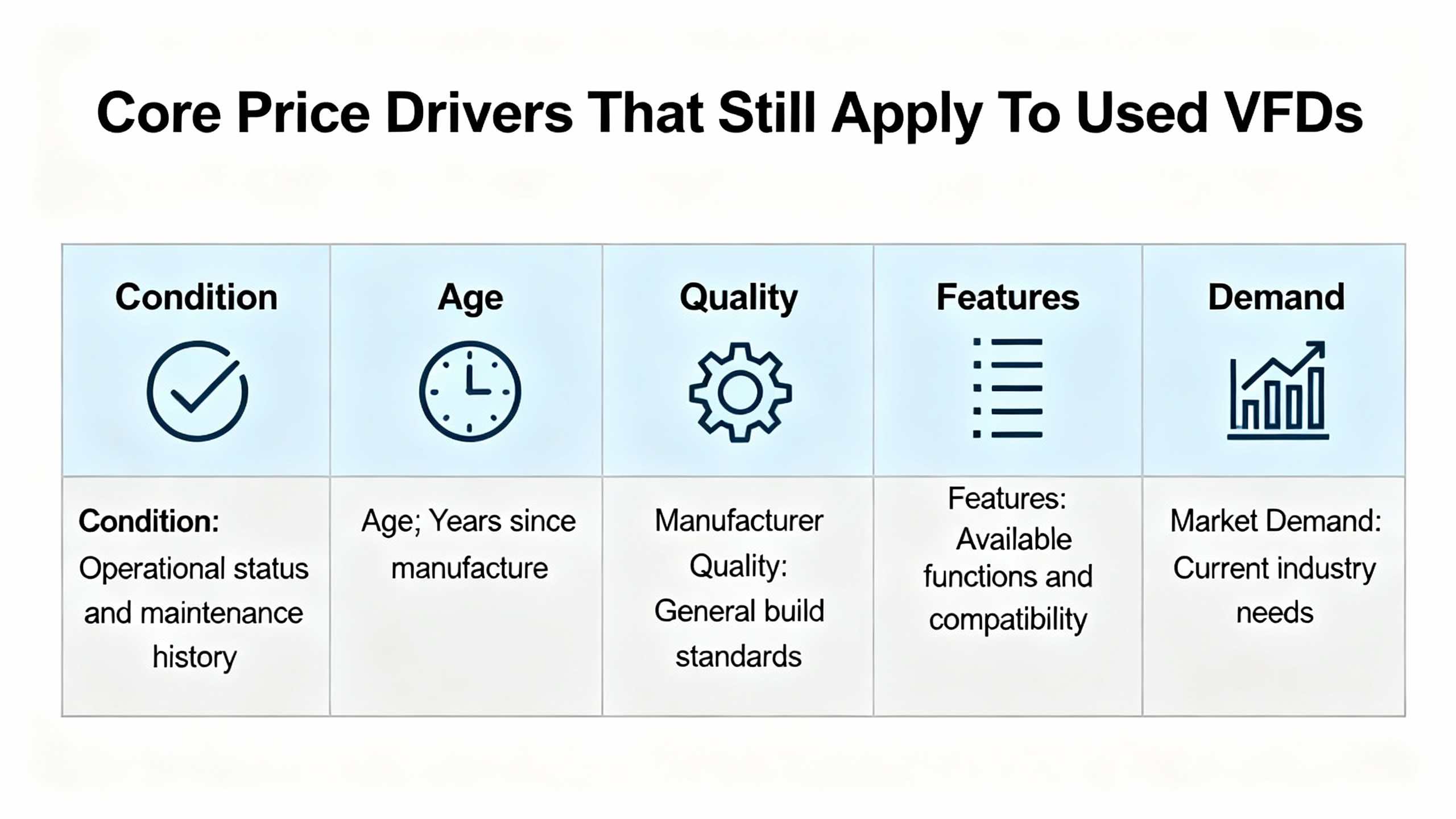
Everything that drives the price of a new VFD still matters when that drive is used or surplus. The difference is that you also have to factor in age, condition, and the credibility of the refurbisher.
Power Rating, Voltage, And Application Duty
Power rating in horsepower is the single most visible cost driver. Drives sized for ten horsepower pumps and fans are fundamentally cheaper to build than drives sized for thousand horsepower compressors. That remains true on the secondary market.
Application duty matters as well. Drives applied to frequent start‑stop, high‑inertia, or constant‑torque loads are often sized more aggressively than simple variable‑torque fan or pump duties. Notes from Mingchuan emphasize that under‑sizing a drive to save money leads to overloads, overheating, and shortened life. If you are buying used, do not pay used‑price money for a unit that is marginal for your load. It will fail early and erase any savings.
Voltage and phase also influence used prices. Drives built for three‑phase power in the 380–480 volt class have more demanding filtering and power‑component requirements than many single‑phase products and tend to be more expensive, new or used. Multi‑voltage capable drives that can be configured for several supply voltages or regions carry extra value because they are flexible stock for resellers and integrators.
At the medium‑voltage level, everything scales up: insulation systems, cooling, footprint, and the stakes if something goes wrong. As Pumps and Systems Magazine points out, these drives are long‑lived, high‑criticality assets. Understanding exactly which voltage class and power range you are being quoted is essential before you judge whether the price makes sense.
Brand, Series, And Feature Set
Brand reputation and specific product series affect pricing even in the secondary market. Established brands with long track records and strong service networks command a premium over unfamiliar names. Canroon’s survey of 2025 price trends notes that global brands such as ABB, Siemens, Schneider Electric, Danfoss, Rockwell Automation, Yaskawa, and Mitsubishi Electric typically sit above generic offerings, while brands like Delta and Canroon itself position as more cost‑competitive, especially in small and medium sizes.
Feature set is entwined with brand and series. Basic drives provide simple speed control. More advanced lines add high‑performance motor control algorithms, built‑in communication protocols, process PID loops, safe‑torque‑off functions, integrated braking choppers, harmonic mitigation, and expanded diagnostics. Both Darwin Motion and Mingchuan stress the importance of specifying only the capabilities you truly need; every additional protocol or option increases cost.
On the used market, this cuts both ways. A heavily optioned drive with features you do not intend to use can be a bargain if the price is low and the unit is healthy, because you get capability you may grow into. It can also be wasted money if that complexity drives up both the purchase price and the commissioning effort. As a rule, I look for used drives whose capabilities match the way the plant actually runs today, with a modest margin for future improvements.
Enclosure, Environment, And Mechanical Packaging
Enclosure type has a major impact on price, and the used market is no exception. Darwin Motion’s overview of price factors highlights the progression from open chassis through NEMA 1, NEMA 12 dust‑tight, NEMA 4 watertight, and NEMA 4X corrosion‑resistant enclosures. Each step up adds cost because you are paying for better protection against dust, moisture, and corrosive atmospheres.
Mingchuan makes the same point in terms of IP ratings and stainless‑steel housings. Drives designed for clean, indoor panels are fundamentally cheaper than wall‑mounted or floor‑standing cabinets with integrated disconnects, fusing, filters, and auxiliary controls. Plug‑and‑play packaged drives cost more upfront but can simplify installation and service.
With used equipment, a harsh‑environment enclosure in good condition is worth a premium, particularly in mining, chemical, wastewater, and outdoor oilfield applications where corrosion and ingress are real threats. However, be very cautious if you see heavy rust, evidence of water ingress, or severe coating damage. You may be buying someone else’s environmental problem.
Condition, Age, And Provenance
New‑drive pricing studies usually set aside condition because new means “unused.” On the used market, condition is everything.
EMA Inc., which both sells new medium‑voltage drives and refurbishes surplus units, stresses that surplus and used VFDs carry perceived risk. They argue that risk can be managed by buying from a vendor who can refurbish, test, and guarantee the equipment. They describe their inventory of surplus medium‑voltage drives, ranging from about five hundred to three thousand horsepower, as including both unused units from canceled projects and used units pulled from service.
This distinction matters. A surplus drive that sat in a controlled warehouse as a project spare is a different asset from a unit that ran hard for ten years in a hot, dusty environment. Neither is automatically good or bad, but they warrant different levels of derating, inspection, and pricing.
Look for documented refurbishment, including replacement of consumables such as fans and capacitors, insulation testing, functional testing under load, and verification of protective functions. Vendor willingness to offer a meaningful warranty on a used package is a strong signal. Vague statements like “tested OK” without any detail are not good enough for critical applications.
Documentation, Firmware, And Compatibility
A used drive with no manual, no parameter backup, and obsolete configuration software is going to cost more to commission than the purchase price suggests. By contrast, a refurbished unit supplied with parameter printouts, wiring diagrams, and the correct configuration tools can be dropped into an existing control architecture quickly.
Several buying guides, including those from Darwin Motion, emphasize the importance of confirming communication protocols and integration details up front. If your plant standard is Ethernet‑based and you pick up a used drive with only a legacy fieldbus, you may end up spending more on new interface hardware or programming time than you saved on the drive.
Firmware also matters. Modern drives often include advanced diagnostics, motor signature analysis, and predictive maintenance features. Pumps and Systems Magazine describes how contemporary VFDs can monitor motor feedback, establish a baseline of normal behavior, detect deviations in load or vibration, and initiate alarms before failures occur. These functions can replace standalone monitoring systems and improve your total cost of ownership. When you buy used, you need to know whether the firmware supports those capabilities and whether any required licenses are included.
Surplus And Used Medium‑Voltage Drives: Big Motors, Bigger Stakes
Medium‑voltage drives deserve special attention in any used pricing discussion because the capital at stake is so large. These drives typically operate in the 2.3–13.8 kV range and serve motors from roughly 150 kW into the hundreds of megawatts. They are used on critical pumps, compressors, fans, and mills in oil and gas, mining, chemical processing, water and wastewater, and heavy industry.
EMA’s discussion of surplus medium‑voltage VFDs makes two points that align with field experience. First, the dominant cost of a medium‑voltage motor is not the purchase price but the electrical power required to run it over its life. Because most of these drives are applied to centrifugal loads, running the motor on a VFD rather than across the line generally generates enough energy savings to more than cover the drive cost over time.
Second, surplus or used drives can be an important lever for capital‑constrained operators, particularly in commodity industries such as oil production where project cancellations and budget cuts are common. EMA reports that it carries surplus medium‑voltage inventory from approximately five hundred to three thousand horsepower, including unused drives from canceled projects and used units removed from service, and that the potential capital savings from these surplus drives can be very large.
Here the link between price and risk is sharp. Market research summarized by Market Growth Reports indicates that a new 1,000 kW medium‑voltage drive can cost in the neighborhood of $80,000.00 to $120,000.00. Saving a meaningful fraction of that by purchasing a refurbished unit is attractive. At the same time, Pumps and Systems Magazine emphasizes that for long‑lived, critical assets like these, total cost of ownership matters more than purchase price.
In a survey of medium‑voltage drive users and specifiers across industries such as mining, oil and gas, chemicals, and water, reliability was rated critical or important by about ninety‑seven percent of respondents, customer service and support by about ninety‑two percent, and price by about eighty‑six percent. The same article notes that unplanned downtime on a refinery pump, for example, can cost hundreds of thousands of dollars per day and that drives with documented multi‑year campaigns without unscheduled shutdowns are the only ones accepted in some nuclear applications.
The implication for used pricing is straightforward. For non‑critical, low‑duty loads, aggressive cost savings on used medium‑voltage drives may make sense, provided basic refurbishment and testing are in place. For critical production assets, paying a premium for a surplus unit from a supplier with deep, proven reliability and support is rational, even if the immediate purchase price is higher than another used option.
How Used VFDs Change Your Total Cost Of Ownership
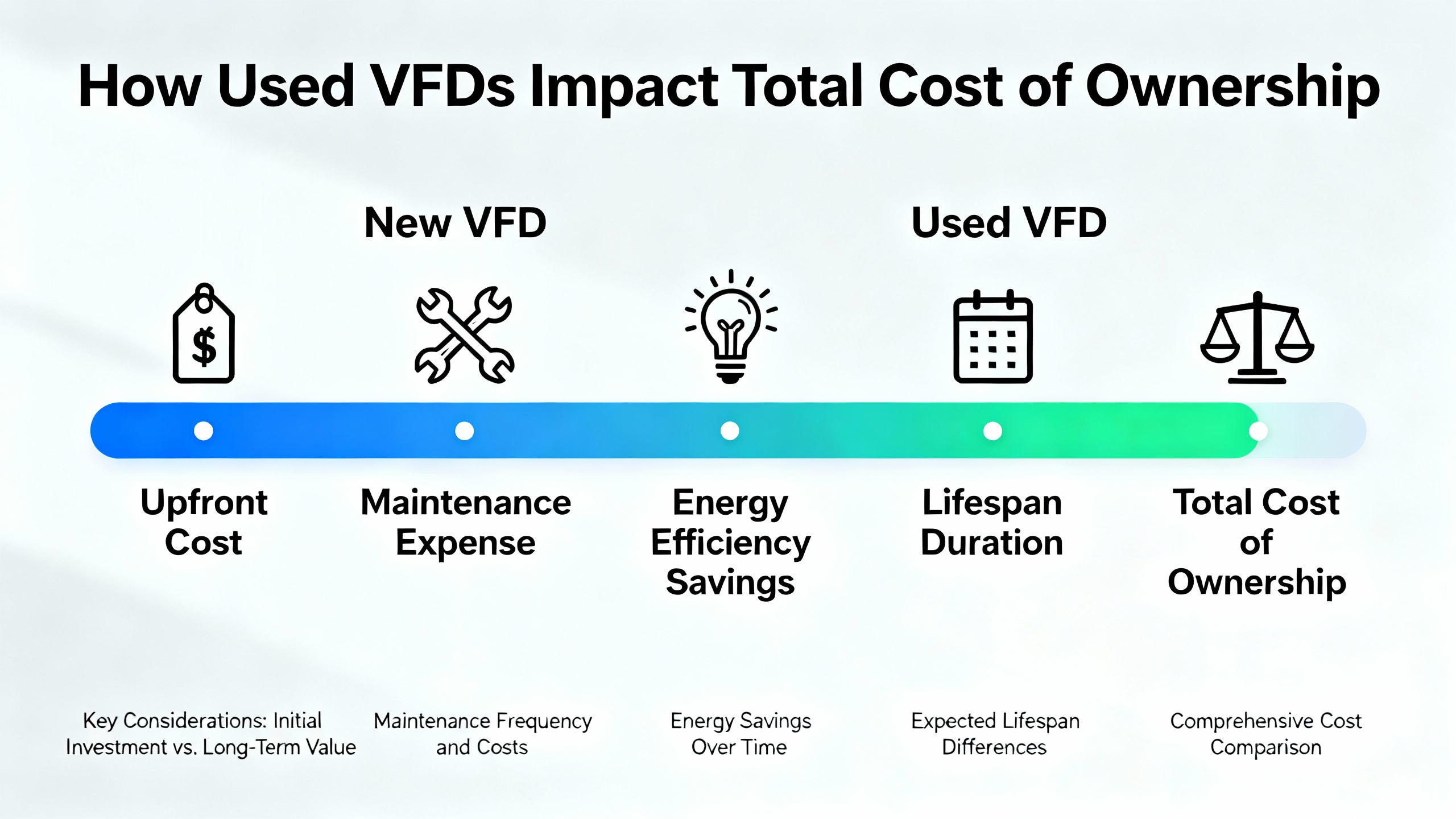
Total cost of ownership, in financial terms, is the net present value of all costs and savings associated with an asset over its life. That includes purchase price, engineering, installation, commissioning, energy use, maintenance, and downtime, with future cash flows discounted because a dollar later is worth less than a dollar today.
Medium‑voltage drives are an obvious case where TCO dominates. However, even for low‑voltage drives in the five to one hundred horsepower range, TCO thinking changes how you judge a used quote.
Several engineering sources note that adding a VFD to a motor installation can increase upfront capital cost by roughly twenty to fifty percent compared with simple across‑the‑line starting, depending on power rating and required accessories. At the same time, energy‑savings analysis from multiple manufacturers and market researchers shows that variable‑speed control frequently delivers payback in the one to five year range, often closer to the low end for heavily loaded pumps and fans that run many hours per year.
Market Data Forecast points out that industrial motor systems account for around forty‑five percent of global electricity use and that deploying energy‑efficient technologies like VFDs at scale is a central lever for decarbonization. With that much energy flowing through your drives, the distinction between “cheap” and “expensive” is not a few hundred dollars of purchase price; it is how the drive affects energy consumption and uptime over a decade.
Modern drives, as highlighted by Pumps and Systems Magazine, come with integrated sensors and analytics that directly impact TCO. They can monitor internal temperature, airflow, vibration, load profiles, and motor signatures, learn what normal operation looks like at your site, and alert operators when behavior drifts. Some can coordinate multiple pumps, balance runtime, and provide basic PLC functionality. When you buy such a drive used, you are not only buying a box that turns a motor; you are buying a local analytics node that can reduce scheduled maintenance and unplanned downtime.
On the other hand, older used drives without those capabilities can still be excellent value in simple, non‑critical applications where energy savings and basic speed control are the dominant economic drivers. The mistake is to evaluate every used drive solely on initial discount from new. Instead, weigh how each candidate will behave in your specific duty over the long haul.
Evaluating A Used VFD Offer Like A Systems Integrator
In practice, the difference between a used drive that performs well and one that causes trouble comes down to how disciplined you are in evaluating the offer. The process is straightforward, but it requires more than glancing at the nameplate and the price.
Start with the application, not the drive. Guidance from manufacturers such as Darwin Motion and Mingchuan is consistent on this point: clearly define the machinery type, motor horsepower, voltage, full‑load current, duty cycle, and any special requirements such as hazardous‑area ratings or regenerative braking. Decide which communication protocols you genuinely need today, and which you might reasonably adopt in the life of the drive. Think about the environment: clean panel room, dusty mill, outdoor enclosure, or corrosive atmosphere.
Next, use current new‑drive price bands as a sanity check. If your application calls for, say, a forty horsepower pump on a standard three‑phase supply, look at the typical new price range for that class. Then examine the used offer. If the used quote is a small fraction of the new price, ask why: is it because the unit is older, from a lower‑tier brand, stripped of options, or sold “as is” without testing or warranty? None of those are automatically disqualifying. In a non‑critical service, they may be acceptable trade‑offs. In a mission‑critical line, they may not.
When you speak with the seller, ask for concretes rather than general assurances. Request a test report that shows insulation resistance, basic functional checks, and where possible, load testing. Ask what, if any, components have been replaced as part of refurbishment. Find out whether parameter backups or original configuration files are available, and whether the seller can assist with integration into your control system.
Suppliers like CM Industry Supply Automation, Darwin Motion, Canroon, and Mingchuan all stress the value of direct, detailed communication between buyer and seller for new drives. That advice is even more important for used units. A good supplier will be happy to talk through your application, suggest appropriate models, and explain where a used drive is a good fit and where you should not cut corners.
Negotiation is normal, but it should focus on value rather than price alone. You can often negotiate not just dollars, but also delivery dates, commissioning support, training, and extended warranties. In some cases, paying slightly more in return for better service levels, faster replacement in case of failure, or local spare‑parts availability is a smart trade.
The table below summarizes the kinds of questions I expect answers to before I recommend a used drive to a plant manager.
| Aspect | What to verify | How it affects price and risk |
|---|---|---|
| Application fit | Motor hp, voltage, current, duty, and environment clearly matched to drive rating and enclosure | Drives that are marginally sized or misapplied may be cheap upfront but expensive in failures; proper sizing supports realistic pricing. |
| Test and refurbishment | Documented electrical tests, replaced fans or capacitors, and functional checks under realistic load where possible | Drives with real refurbishment and test data justify a higher used price and carry lower operational risk. |
| Features and integration | Confirmed communication protocols, I/O capability, and firmware features aligned with your control architecture | Mismatched protocols or missing features drive extra integration cost, reducing the value of a low sticker price. |
| Warranty and support | Clear warranty terms, access to technical support, and availability of spares from the vendor or OEM | Better warranty and support increase price but reduce downtime risk and total cost of ownership. |
| Provenance and age | Whether the unit is unused surplus, a lightly used spare, or heavily run production equipment, and approximate age | Surplus or lightly used drives from canceled projects can be priced closer to new; heavily used units should be discounted and possibly derated. |
If you consistently walk through those points, you will find that truly “cheap” used drives are rarer than marketing suggests, but genuinely cost‑effective ones stand out clearly.
When Does A Used VFD Make Strategic Sense?
Used and surplus drives are not a universal answer. There are situations where they are particularly well aligned with operational and financial realities.
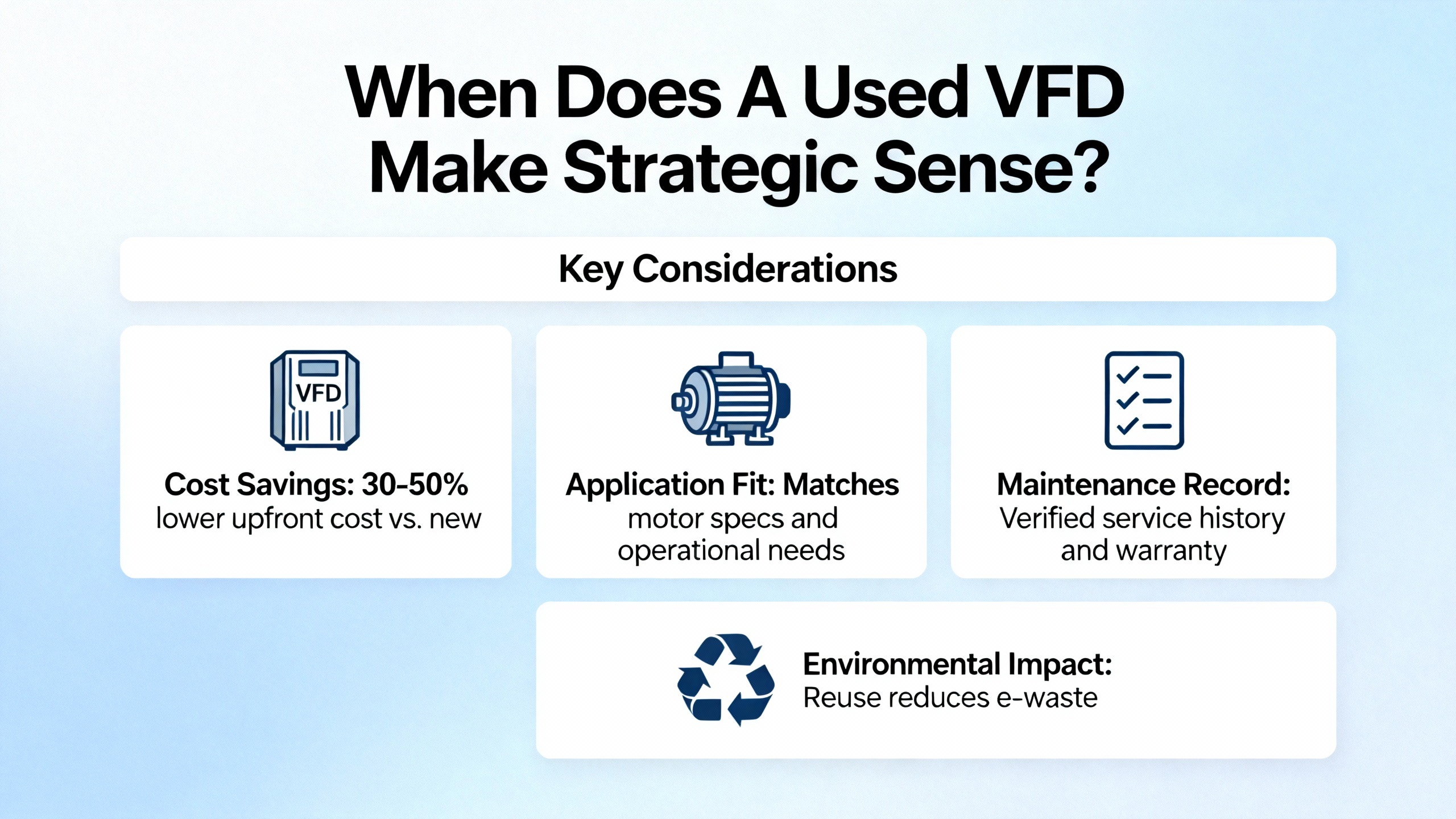
They make the most sense when you need to add or replace a drive on a defined duty where the process is well understood, the performance requirements are stable, and the risk of a shorter remaining life is acceptable. Examples include secondary pumps and fans, temporary bypass systems, pilot lines, and non‑critical auxiliary equipment. In these cases, the ability to acquire a suitable drive at a significant discount to new, especially when a reputable refurbisher has tested and guaranteed it, can free budget for other improvements.
They also make sense in capital‑constrained environments where the main risk is not that a drive may eventually need replacement, but that the project does not happen at all if new‑drive funding cannot be secured. EMA’s commentary on surplus medium‑voltage drives in oilfield applications fits that pattern. For operators faced with project cancellations due to commodity price swings, surplus drives from canceled projects can bridge the gap.
On the other hand, new drives are usually the better choice for long‑term, high‑criticality assets, for standardization programs across multiple sites, and for applications that depend on the latest features in motor diagnostics, safety, or connectivity. In those cases, aligning with current product lines from major manufacturers and securing full warranty and support is worth the extra capital, especially given typical one to five year payback periods on energy savings alone.
Short FAQ
Q: How much cheaper should a used VFD be compared with a new one?
There is no single percentage that is always correct, and the research summarized here does not publish a standard discount. The right comparison depends on brand, power rating, enclosure, features, age, condition, and the depth of refurbishment and warranty. The pragmatic approach is to anchor your expectations against up‑to‑date new‑drive price ranges for a comparable model, then adjust based on concrete evidence of testing, documentation, and support. A heavily refurbished, lightly used drive with a solid warranty will naturally sit closer to new pricing than an older, untested unit sold as is.
Q: Is it safe to put a used drive on a critical pump or compressor?
It can be, but only if you treat it as a TCO decision, not a bargain hunt. For critical services, I only recommend used drives from suppliers who can provide clear refurbishment procedures, documented tests, and a warranty that aligns with the risk and downtime cost. Surveyed users of medium‑voltage drives consistently rank reliability and support above initial price, and for good reason: the cost of a major unplanned outage can dwarf any savings on hardware.
Q: Where should I start if I have never bought a used VFD before?
Start by specifying your application as though you were buying new: motor data, process needs, environment, and control architecture. Use published new‑price benchmarks from manufacturers and market studies to understand the ballpark. Then speak directly with suppliers who specialize in both new and surplus drives, share your requirements, and ask for itemized, documented quotations. If a supplier cannot answer basic questions about testing, refurbishment, and warranty, treat that as a signal to keep looking.
Closing Thoughts
Used VFDs are neither a silver bullet nor a shortcut; they are one more tool in the project toolbox. When you ground your decisions in application requirements, realistic new‑drive benchmarks, and a disciplined view of total cost of ownership, used and surplus drives can deliver real value, especially in budget‑tight environments.
From the integrator side of the fence, the projects that succeeded with used drives all had one thing in common: the team treated those drives with the same engineering rigor they would apply to a new, high‑end package. If you apply that mindset, you can let the numbers, rather than wishful thinking, tell you when a used VFD is the right move for your plant.
References
- https://emainc.net/surplus-medium-voltage-vfds-a-viable-way-to-cut-costs/
- https://d3mm496e6885mw.cloudfront.net/manufacturer_product/5919d9d2e4b0b6f46aff2a4b/project/projects/original/Cost_Considerations_VFD_FINAL.pdf
- https://www.fortunebusinessinsights.com/hvac-variable-frequency-drive-market-104845
- https://www.pumpsandsystems.com/determine-total-cost-ownership-when-selecting-medium-voltage-drives
- https://www.ask.com/news/cost-factors-consider-repairing-vfd-drive
- https://www.canroon.com/Industry-Insights/vfd-price-comparison-2025-cost-effective-brands-suppliers
- https://cmindustrysupply.com/blogs/price-of-variable-frequency-drive
- https://darwinmotion.com/blogs/how-to-check-variable-frequency-drive-prices-a-comprehensive-guide
- https://www.futuremarketinsights.com/reports/global-variable-frequency-drives-market
- https://www.gminsights.com/industry-analysis/variable-frequency-drive-vfd-market
Keep your system in play!
Top Media Coverage
Categories


Related articles Browse All
-
 BlogImplementing Vision Systems for Industrial Robots: Enhancing Precision and Automation2025-08-12 11:26:54Industrial robots gain powerful new abilities through vision systems. These systems give robots the sense of sight, so they can understand and react to what is around them. So, robots can perform complex tasks with greater accuracy and flexibility. Automation in manufacturing reaches a new level of ...
 -
 BlogOptimizing PM Schedules Data-Driven Approaches to Preventative Maintenance2025-08-21 18:08:33Moving away from fixed maintenance schedules is a significant operational shift. Companies now use data to guide their maintenance efforts. This change leads to greater efficiency and equipment reliability. The goal is to perform the right task at the right time, based on real information, not just ...
 -
 BlogThe Evolution of Steam Turbine Control Systems2026-03-31 08:33:35CALL US:+86-18020776786 | E-MAIL:INFO@AMIKON.CN In-depth analysis of the GE Mark VIe control system Mark VIe: A Modern Mainstay for Industry 4.0 Mark VIe's core concepts are "high availability, open connectivity, and intelligent readiness." It utilizes comm...


- Q&A
- Policies How to order Part status information Shipping Method Return Policy Warranty Policy Payment Terms Email Marketing Policy VAT and Import Information
- Asset Recovery
- We Buy Your Equipment. Industry Cases Amikong News Technical Resources Why choose us FAQs
- Registered Address
-
32D Guomao Building, No.388, Hubin south Road, Siming district, Xiamen,Fujian, China

Leave Your Comment